A recent Reinsurance News poll, which drew responses from hundreds of industry professionals, suggests that regulatory mandates are viewed as the primary driver for the adoption of environmental, social, and governance (ESG) principles within the re/insurance sector.
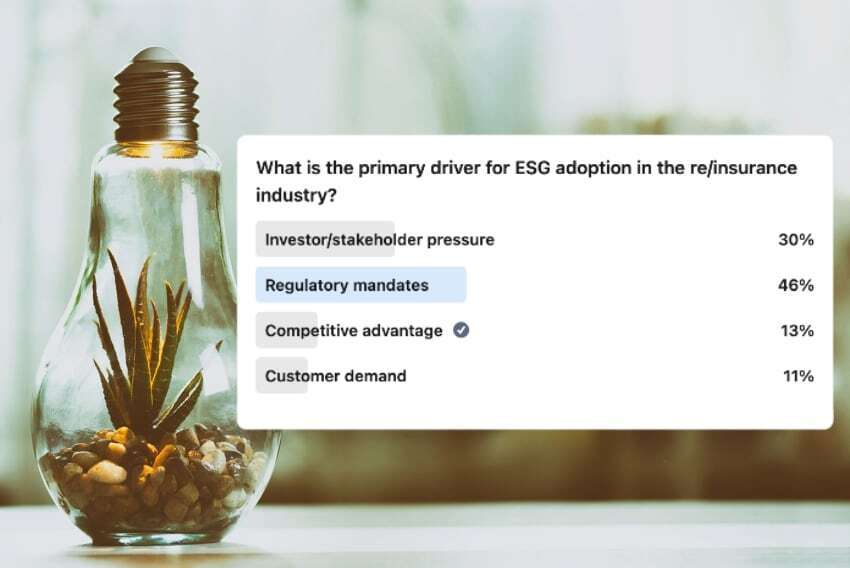 Of the poll respondents, 46% identified regulatory mandates as the most influential factor driving ESG adoption, underscoring the growing importance of aligning with strict and often complex legal requirements. This priority is mirrored in ongoing industry efforts to improve ESG reporting and transparency.
In alignment with our findings, collaborations like the MSCI and Moody’s partnership reflect how companies are responding to these pressures.
By combining MSCI’s ESG ratings with Moody’s existing platforms, the partnership provides tools to navigate increasingly stringent reporting standards.
These tools help organisations align with emerging mandates, such as those set by the European Union’s Corporate Sustainability Reporting Directive (CSRD). This directive places a heightened emphasis on comprehensive sustainability disclosures, including those from private companies, a focus that Moody’s is addressing through its expanded ESG insights.
Investor and stakeholder pressure, cited by 30% of poll participants, also plays a significant role in ESG adoption. This influence is evident in the push for more transparent ESG metrics, which has led companies to seek innovative solutions. Partnerships like Moody’s and MSCI’s are helping bridge this gap by offering clients the insights needed to satisfy both regulatory and stakeholder expectations.
Similarly, the partnership between Concirrus and the 90 North Foundation demonstrates how firms are leveraging technology to meet environmental and governance goals. Through its Quest One platform, Concirrus provides detailed analytics on maritime activity in the Arctic, a region subject to environmental regulations aimed at preserving biodiversity.
Pen Hadow, Executive Director of 90 North Foundation, said: “Concirrus is making available to 90 North Foundation mission-critical raw and processed data about all vessels and their movements in the Arctic Ocean.
“This data enables our research partners to integrate, quantify and forecast the impacts of vessel activities with existing research on Arctic marine biodiversity. The resulting spatial mapping of risks to individual species and ecosystems will inform the optimal conservation measures needed to protect the region’s vulnerable wildlife as its sea-ice habitat recedes.”
These data-driven tools help organisations align their operations with regulatory standards while also addressing the environmental concerns of stakeholders and investors.
Further down the poll’s results, customer demand and competitive advantage ranked as less significant drivers, accounting for 11% and 13% of responses, respectively. While these factors may play a smaller role, they remain important considerations, especially in niche markets where customer preferences or innovative ESG practices can provide a competitive edge.
Ultimately, the findings of the poll reflect a broad industry alignment with regulatory expectations as the leading force behind ESG efforts. However, the impact of stakeholder pressures and the strategic use of partnerships like those of MSCI-Moody’s and Concirrus-90 North Foundation suggest that ESG adoption is a multifaceted endeavour.
As the re/insurance sector continues to evolve, the interplay of regulatory mandates, stakeholder demands, and innovative solutions can shape how organisations address sustainability challenges in the years ahead.