Following an insurance broker selloff earlier this week, widely attributed to our report that OpenAI approved the first AI app from an insurance provider on ChatGPT, several analyst firms weighed in on the roughly 9% average decline in the stock price.
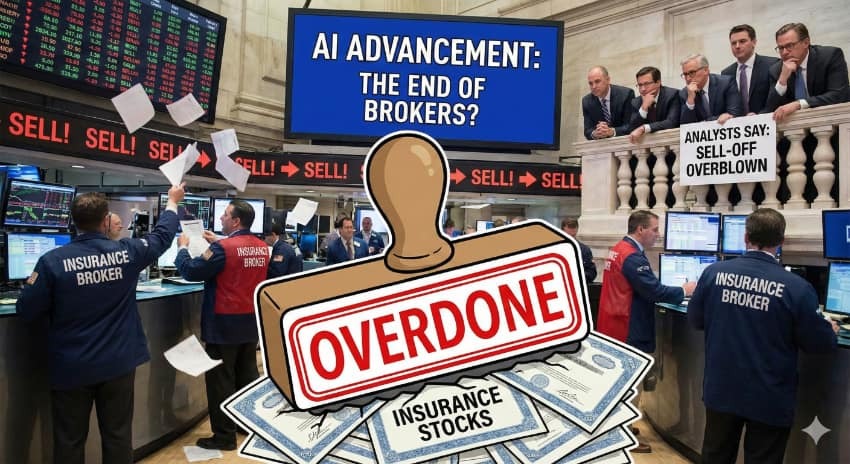 Many described the drop as “overdone” or an “overreaction”, with some emphasising the short-term resilience of the broker business model.
However, other analysts suggested the selloff reflects investor concerns over potential disintermediation, as AI platforms increasingly allow carriers to reach consumers directly at the point of initial search.
Yesterday, the approval of the first AI app from an insurance provider on ChatGPT was announced.
The app is developed by Tuio, one of Spain’s leading digital insurers, and powered by WaniWani’s AI distribution infrastructure.
This wave of news triggered a selloff in the insurance brokers segment, prompting responses from several leading analysts.
Goldman Sachs, for example, said that from a fundamental perspective, it views the 9% decline as “overdone”.
Goldman Sachs added, “As one might expect, artificial intelligence discussions are becoming more prominent on insurance earnings calls. Both Financials and Insurance sector companies tend to discuss AI in the context of productivity more often than other sectors, which we attribute primarily to the ability to train AI on large and often proprietary data sets, in addition to a large portion of labour costs exposed to AI automation.
“Within insurance, we believe AI with respect to autonomous vehicles has already been adding pressure to shares, while yesterday we saw arguably the first clear instance of an AI narrative impacting the insurance brokers.
“Thus far, it appears investors have placed commercial insurers in a medium-term beneficiary camp, though with acknowledgement that longer-term cost savings could get passed onto the insureds.”
Analysts at KBW also weighed in, echoing Goldman Sachs, noting that they view the sell-offs, especially in commercial brokers, as a significant overreaction, given that OpenAI integrations currently serve only as lead-generation tools for personal lines.
“Even assuming future purchasing capability, we see these tools as another form of direct-to-consumer marketing with a likely limited impact on commercial insurance brokerage, for which complexity and insureds’ growing need for customisation will likely long warrant an actual advisor,” KBW added.
However, KBW noted that the announcement helps explain the insurance brokers’ significant weakness, reflecting investor concerns about potential disintermediation as AI platforms enable carriers to reach consumers at the point of initial search.
J.P. Morgan, meanwhile, framed the recent volatility as a “thought experiment for an AI world”, acknowledging a credible bear case in which AI agents embedded within platforms like ChatGPT could disintermediate human brokers in personal lines over time.
The bank outlined a scenario where consumers begin and end their insurance journey within AI ecosystems, increasing price transparency, churn and competition.
However, it argued that leading personal lines brokers can adapt by developing their own digital agents and AI-enabled distribution, even if the transition creates operational disruption and pressures cash flow as models shift toward more DTC marketing.
For now, J.P. Morgan expects human and AI-led distribution to coexist, with the market still “open enough” for incumbents to defend their competitive positions.
Elsewhere, BMO Capital Markets observed, “Insurance brokers have underperformed the market by >10% over the past two days. Part of the influence appears driven by a continued wave of AI-related uncertainty regarding potential disintermediation of insurance brokers within the insurance purchasing value chain.”
BMO continued, “While we don’t have a crystal ball as to how AI will impact our sector’s income statements over the long-term, we feel it’s reasonable to estimate insurance brokers’ near-term (1-2 years out) revenues will not be impacted by a magnitude that’s anywhere close to the >10% selloff witnessed in recent days.”
TD Cowen also pegged the sell-off as an “overreaction, stating that it does not expect material commercial broker disintermediation from AI in the intermediate term.
TD Cowen added, “Given the fast-changing nature of AI capabilities/uses, it is hard to definitively rule out any impacts.
“That said, we think any such pressures would be gradual and incrementally modest and should be more than priced in, given the pressure on brokerage stocks in recent months, in addition to today.
“Moreover, the margin benefits should also be considered. As such, while AI newsflow may continue to drive near-term volatility in broker stocks, we see current price levels as an attractive entry point.”
In their take, Evercore ISI analysts concluded that insurance broker business models are durable, citing the advisory nature of broker-client relationships and the potential downside risks that customers can avoid by using a broker.
Evercore concluded, “Brokers have data and scale that allow them to not only inform risk management decisions but also garner more favourable terms from insurers than in the direct channel.
“This is not as simple as changing a software solution–it would be customers changing the way risk management decisions are made to save on commissions in exchange for potentially exposing themselves to the risk of not having sufficient coverage.”