Analysts at re/insurance broker Aon have estimated that insured catastrophe losses during the first half of 2021 amounted to $42 billion.
This is roughly in line with the 10-year average of $41 billion, but 39% above the average for the 21st Century so far, which stands at roughly $30 billion.
On the other hand, economic losses came to $93 billion, which is 32% below the 10-year average of $136 billion and 16% lower than the average of $110 billion since the year 2000.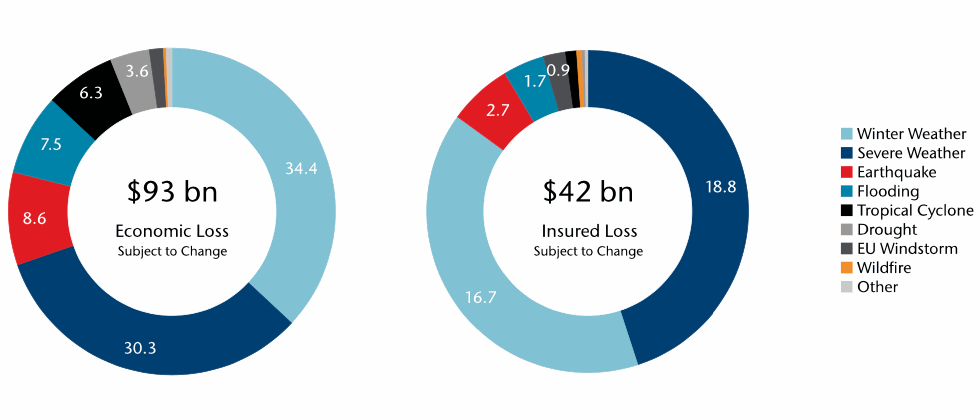
There was a minimum of 163 natural disaster events that occurred in 1H 2021, which was below the 21st Century average (191) and median (197), although it’s worth noting that Aon’s database only includes events that meet certain criteria.
The first six months of the year were marked by fewer event occurrences, but dominated by several large-scale, billion-dollar, and high-impact events.
From a natural peril standpoint, there was a relative lack of significant earthquakes and a less severe start to flood / monsoon seasons in parts of Africa and Asia, Aon notes.
Insured losses resulting from natural catastrophes were notably 76% above average in the US and 32% above average in EMEA when compared to the 21st Century H1 average, while losses in APAC and the Americas (non-US) were below average -1% and -54%, respectively.
Aon attributed the higher than average industry payouts in the US to the record winter storm losses, plus another high-cost six months for severe convective storms.
There were at least 10 separate events that caused billion dollar insured losses over the first six months of the year, all but one of which were weather-related.

Severe convective storms generated 6 billion-dollar events in the United States alone, while two occurred in Europe within a two-week span in late June.
However, the costliest event, by far, was the Polar Vortex-induced prolonged period of extreme cold in the United States. This event was expected to continue showing loss development for months to come.
In terms of economic losses, there were at least 22 separate billion-dollar events in H1, all of which were weather-related with the exception of the February 13 earthquake near the coast of Japan.
In total, the US saw 10 billion-dollar events, while APAC had 6, followed by EMEA at 4, and the Americas at 2.