Asbestos & environmental (A&E) loss reserves have declined steadily, but not significantly, over the past decade as loss payments have outpaced incurred losses, according to a new AM Best report.
The rating agency reported that asbestos reserves declined 3.7% to $18.4 billion from 2017, while environmental reserves rose a slight 2.6% to $5.3 billion.
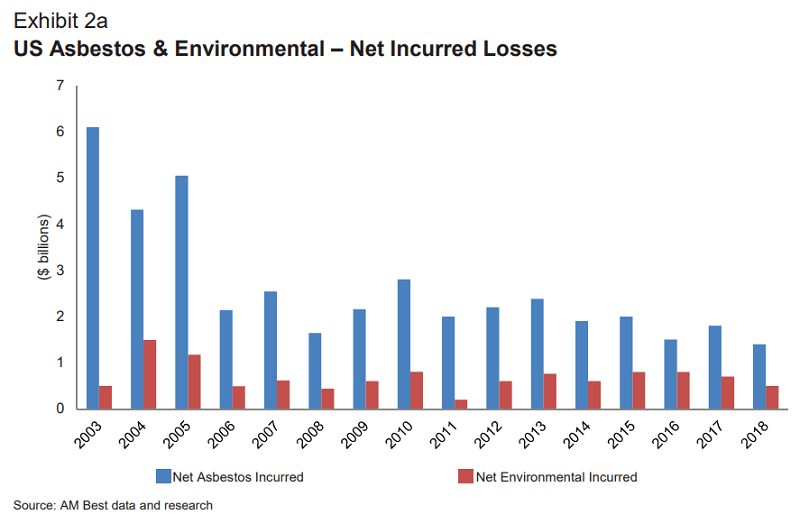
Over the past five years, the re/insurance industry has paid out $16.8 billion for all A&E claims, while incurring $12.0 billion in losses.
During this period, it incurred $8.6 billion in asbestos losses and paid out nearly $13.5 billion, while for environmental losses it incurred more than $3.4 billion and paid out $3.3 billion.
However, asbestos losses have started to show signs of subsiding, analysts noted, and have declined 23% over the past five years. In 2018, asbestos paid loss declined 14% to $2.1 billion, falling below the long-term average of $2.5 billion.
Asbestos still accounts for almost 80% of A&E liabilities, but quantifying the ultimate loss exposure remains difficult given the continued evolution of medical effectiveness, as well as evolving litigation strategies.
AM Best continues to estimate A&E losses for the US property and casualty industry at $100 billion and $46 billion at year-end 2018, respectively.
At current payout levels, both asbestos and environmental reserves will run off within approximately seven years, the firm predicted, assuming no additional reserve strengthening.
Just 30 re/insurance companies continue to account for nearly 90% of total A&E paid losses, and are responsible for around 95% of the industry’s total A&E reserves.
AM Best also found that eight groups incurred net A&E loss of $100 million or more in 2018, of which six incurred asbestos losses exceeding $100 million and one incurred environmental losses exceeding $100 million.
Berkshire Hathaway remained the top A&E re/insurer in terms of net reserves in 2018, with more than 10% of total reserves, followed by AIG at 9%, then Swiss Re, The Hartford, and Travelers.
15 companies accounted for 81% of the industry’s average annual A&E incurred losses, with five accounting for just over 45% of the five-year average, AM Best said.
These rankings remain unchanged from 2017, with Travelers in the top spot, followed by The Hartford and AIG in second and third place, respectively.
The reinsurance segment in particular experienced the biggest impact to its combined ratio due to A&E exposures last year, analysts noted, driven by losses at Sirius America Insurance Group and Swiss Re.