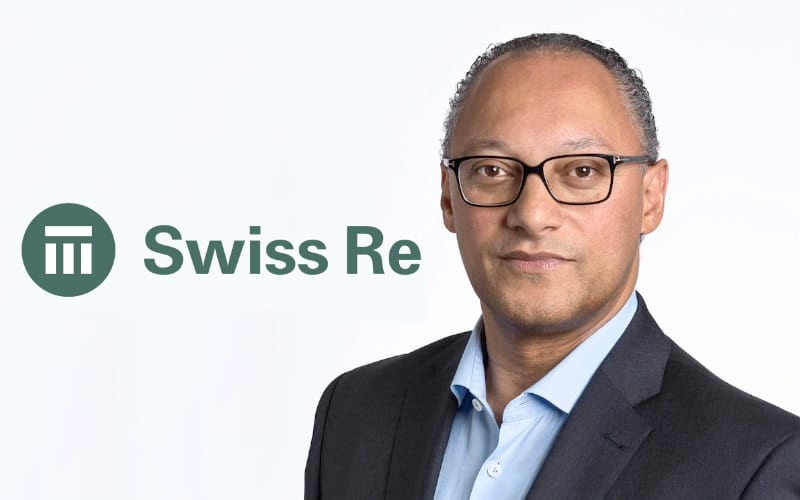
Although some large buyers of reinsurance decided to take more risk at the January 1st renewal season, global reinsurer Swiss Re’s share of wallet in the market didn’t reduce as buyers still need lead reinsurance partners, according to Andreas Berger, Group Chief Executive Officer (CEO) at Swiss Re, one of the world’s largest reinsurance companies.
 Alongside the release of its results for the 2025 financial year this morning, Swiss Re revealed the outcome of its January 1st 2026 renewal, announcing a -0.3% premium volume change and a -4.6% net price change, driven by 4.6% higher loss assumptions, very slightly offset by a 0.3% nominal price increase.
Roughly 55% of the company’s treaty business renewed in January, and of the $12.5 billion up for renewal, $600 million was either cancelled or not placed, meaning 95%, or $11.8 billion was renewed. If you then include a 2%, or $300 million change on renewed, and $900 million of new business, total premium volume at the renewal totalled $12.4 billion.
By line of business, Swiss Re reduced the size of its nat cat book by 7% with a gross premium volume of $2.4 billion, while the property book retracted by 6% to $1.9 billion, offset by 3% growth in specialty and 4% growth in casualty to $2.8 billion and $5.3 billion, respectively.
Swiss Re explained this morning that the reduction in nat cat reflects nominal price declines in a more competitive market, but added that, importantly, terms and structures were broadly stable.
During a recent call with the media, CEO Berger was questioned on the drivers of the softening environment, leading the executive to highlight the importance of cycle management, and also Swiss Re’s prominent market position.
“First of all, let me state there is not one cycle. So, it’s very important to say, because each line of business is in a different market cycle. There might be a few lines that are correlated to each other, but not in general. That’s what I said around the lines of business like credit/surety, which I mentioned before, which is not correlated to the traditional property and casualty lines of businesses,” said Berger.
He continued: “For the renewals, we have seen demand, but we have seen also higher competition on the supply side. So, there’s capital, abundant capital in the market, and that is reflected in a more intense pricing competition. The good news is that the structures stayed broadly intact, the terms and conditions and attachment points, and that’s something we need to observe, and we need to keep that discipline in the market.
“We’ve seen the sophisticated and very large reinsurance buyers, they have taken more risk, so meaning taking premium out of the market. But again, the good news is they need lead reinsurance partners, so our share of wallet in the market didn’t reduce.”
The CEO went on to note Swiss Re’s active role in the intersection between the liability and the asset side, and also the capital markets, underlining the firm’s leading role in the establishment of the insurance-linked securities (ILS) market.
“So, this is normal cycle management. There’s parts of the cycle when rates go up. Then parts of the cycle, when, due to the high rates, investors think there’s an attractive market, capital will come in, it puts more pressure on pricing, competition goes up. Here, technical excellence, technical underwriting, how do you assess a risk? How do you price risk? Is very important. And you always have to look at rate adequacy and about composition of your portfolios and protecting your balance sheet,” he said.
Looking ahead to future 2026 renewals, Berger said that Swiss Re is expecting similar dynamics to 1.1 2026, adding that, as ever, this could change if there’s a huge loss.
“We’re going now into the April renewals; they’re mainly Asia or Japan driven. Again, the Japanese market is a very different market to the US market, or European markets. And then you go into the June/July renewals in the US, everybody’s waiting for that, obviously. So, let’s see. I think it’s higher demand. So, always a good sign. There’s demand for the product, and we just need to have discipline in keeping the rates adequate and keeping the structures disciplined,” said Berger.