Most Bermudian re/insurers have adopted a hybrid model as a common solution to volatility, says a recent S&P report.
 Several years of obstacles, which have included a barrage of catastrophic events, the COVID-19 pandemic, rising inflation, and the ongoing Russia-Ukraine conflict have exacerbated losses for the global insurance industry.
Yet with any challenge comes opportunity, suggests S&P, with Bermudians’ top-line growth averaging 14.1% in the past five years, with total gross premiums written (GPW) reaching $69.3bn in 2021.
The growth occurred organically through acquisitions, says the report, such as AXIS acquiring Novae in 2017, RenaissanceRe acquiring Tokio Millennium Re in 2019, and Sirius International merging with Third Point in 2021.
The report states that low-interest rates in 2020 and 2021 allowed many companies to raise capital amid already hardening reinsurance pricing to deploy in both reinsurance and insurance lines.
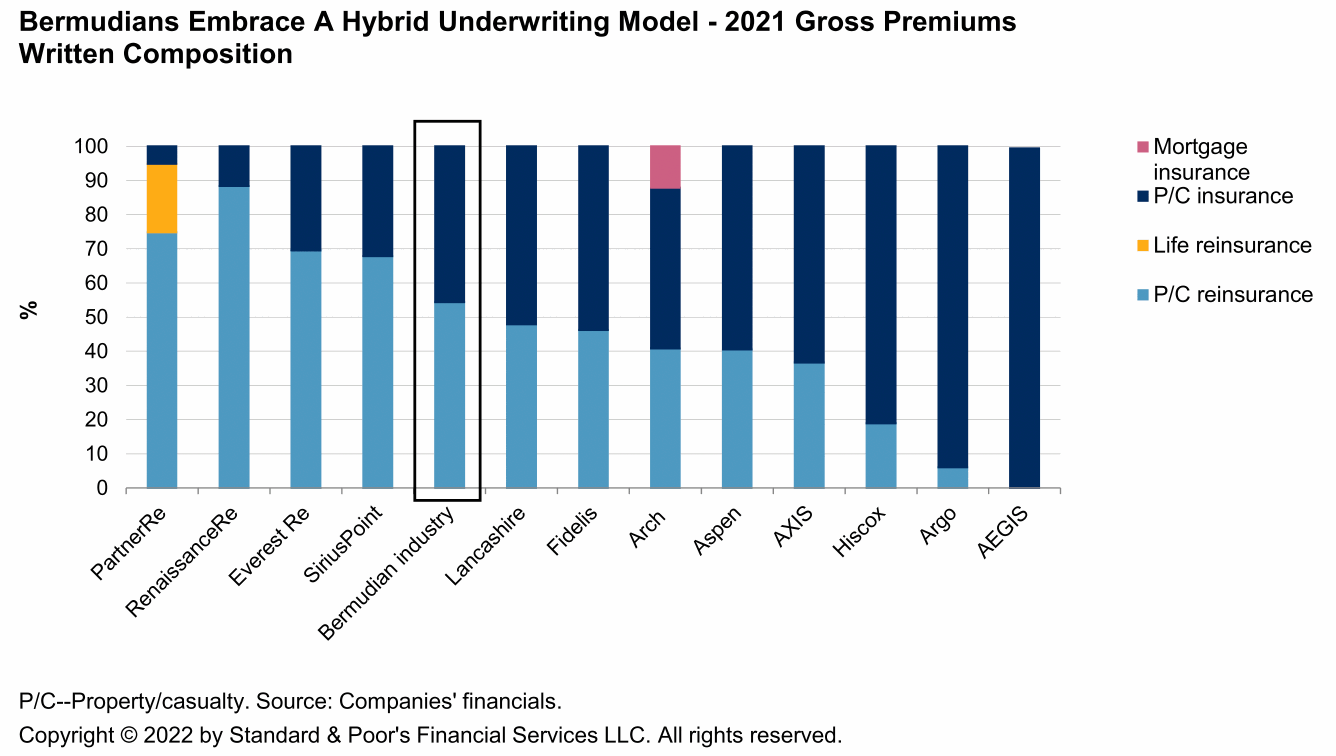
S&P note Bermudian re/insurers raised $8.7 billion of fresh capital, including equity raises of $2.8 billion and debt of $5.9 billion. Bermudians’ insurance GPW grew by 18.9% in 2021 to $31.6 billion, while reinsurance GPW grew 24.5% to $37.7 billion.
According to the report, most Bermudian re/insurers have adopted a hybrid model and are looking to increase their diversification in less volatile insurance lines to help manage their businesses’ volatility.
Everest Re, for example, has a multiyear plan to realign its business risk by growing its insurance book more rapidly than reinsurance, with the intent to deliver improved risk-adjusted operating margin with reduced volatility.
AXIS is another example, after the company announced it would exit property and property catastrophe reinsurance lines and focus more on growing its primary specialty insurance business.
This year’s renewals have underscored the dislocation in the reinsurance market, says the report, with property catastrophe-exposed capacity remaining constrained.
Given the challenges in the reinsurance market, S&P expect Bermudian re/insurers will continue to reshape their underwriting portfolios, reducing earnings volatility by further diversifying into less volatile lines and primary insurance business.