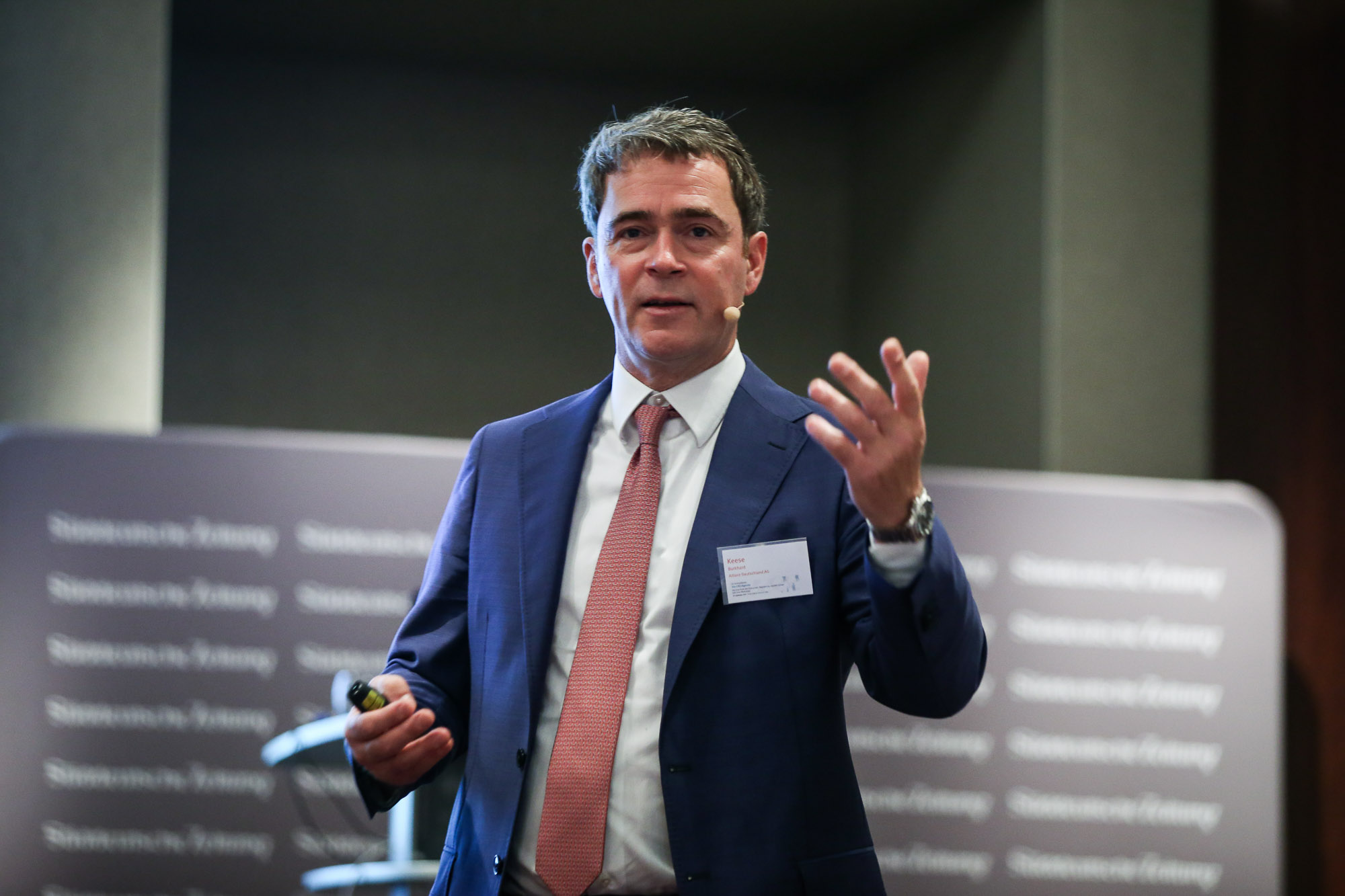
It’s likely the hardest market in reinsurance since the aftermath of 2005, but as Hurricane Ian’s impacts accelerate the trend with additional firming anticipated for the months ahead, it’s important for underwriters not to get carried away, according to Burkhard Keese, Chief Financial Officer (CFO) of the specialist Lloyd’s re/insurance marketplace.
 In the reinsurance universe, true hard markets are a rarity. According to analysts and executives who have been operating in the space for a long time, it’s likely that the current hard market is the hardest for 17 years, after the extremely active 2005 Atlantic Hurricane season, which included Hurricanes Katrina, Rita, and Wilma.
Following the 2008 global financial crisis, some did describe the market as hard, but the consensus seems to be that it’s currently the firmest reinsurance market for 17 years.
That’s a long time; and the fact is many working in the space today, whether underwriters or brokers, have not experienced a hard market before. At some companies, it’s possible that the large majority of staff have never worked through a hard reinsurance market, while at others it will be a different story.
But what does this mean for the hard market itself? And is there a risk for reinsurance companies lacking hard market experience?
According to Keese, speaking yesterday during an AM Best event, “the biggest risks they have, is that they are not nimble enough to deal with the needs.”
At the same time, he continued, “the biggest problem in a hard market is you may have not enough capital that you would like to have. This is always the biggest problem.”
He went on to explain that, during a hard market, sometimes it can be tempting to move quicker than you should in order to grow.
“I think that’s a risk that you just get carried away and then maybe you are part of making the market more soft,” said Keese. “And there’s a good reason why the market is hard, because we have lost over years billions of pounds, and we must earn that back and people always forget that.”
Since 2017, Keese explained that the marketplace has lost a lot of money. After all, 2022 is set to be another year of insured catastrophe losses of more than $100 billion, while the market has also had to deal with the COVID-19 pandemic and the ongoing impacts of Russia’s invasion of Ukraine.
“I think the biggest risk is really to get carried away that you believe it is hard and therefore I can maybe give a 5% discount. I think that’s a mistake. You should really have your technical price, you should have your procedures, and your price adequacies always under control, and then you must be confident to do that,” said Keese.
“On our side, on the oversight side, we must be prepared to react fast because cycle management means for me always the same: you must grow in a hard market to restore capacity in a soft market. It’s two sides of the same coin. If you don’t grow, you can’t restore capacity, and that’s what you need to do to find then the soft market again,” he concluded.
Whether it’s the hardest market ever or not remains to be seen, but it’s clear that Ian’s devastating impacts has accelerated firming in the market, with many now expecting rate improvements in not just loss-hit lines and regions, but on a more widespread basis.