Swiss Re has estimated that the insurance protection gap for earthquake risk in Japan remains extremely high at $25 billion despite significant risk mitigation efforts and cultural preparedness.
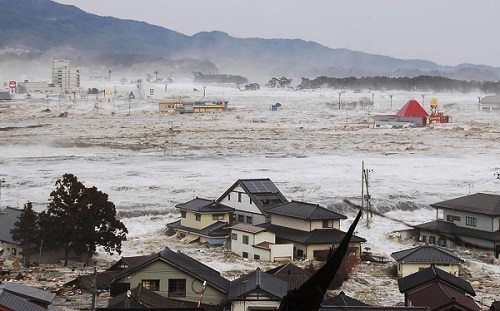
The city of Rikuzentakata, Iwate Prefecture, following the earthquake and resulting tsunami in 2011. Source: Kyoto
According to Swiss Re, underinsurance of seismic risk makes up the majority of Japan’s natural catastrophe protection gap, which is the second highest in the world at $30 billion in premium equivalent terms.
Yet insurance penetration for seismic risks in Japan remains low, with a majority of firms and SMEs still lacking protection, despite an increase in take up over the 10 years since the Great East Japan Earthquake in 2011 and its ensuing tsunami.
This event caused economic losses of $210 billion and claimed 18,000 lives, and resulted in a strengthening of Japan’s already-high standards of disaster mitigation.
Insurers too have rethought their risk assessment models, specifically to better factor in perils like tsunami, after covering just $35 billion, or 16%, of the losses from the 2011 quake.
Japan is one of the most earthquake-prone countries in the world and enforces rigorous building codes, as well as early warning systems and dykes for tsunami risk. But 2011 shows that the country remains vulnerable to very low frequency but high-impact worst case scenarios for earthquake and tsunami, Swiss Re notes.
And while defences and insurance take-up have improved over the past decade, there is the potential for even more devastating earthquake events to occur, for instance if a similar magnitude quake where to hit an area of more dense population and value concentration, such as Tokyo.
Swiss Re also observed that, despite advancements in seismic science, often the scale of associated loss potential from earthquake events is not fully recognized, even in countries with a long recorded seismic history like Japan.
However, following the 2011 earthquake, insurance industry modelling of secondary perils like tsunami and, in the case of New Zealand, liquefaction, and also of the loss potential of buildings’ non-structural elements has progressed.
And as modelling of all loss drivers improves and mitigation of worst-case scenarios is strengthened, Swiss Re believes that the industry will be able to contribute more to offload earthquake risk from businesses and households.
Currently an estimated 50% to 60% of households in Japan have earthquake insurance, although with coverage limits in residential policies ranging from 20-50% of fire sum insured, the share of overall losses compensated for is around 15%.
“That’s up from 3% at the time of the 1995 Kobe quake, but is well below levels in other also earthquake-prone countries like Chile (30%) and New Zealand (75%),” Swiss Re noted. “These discrepancies suggest there is still more to do to extend the reach of earthquake covers across Japan.”