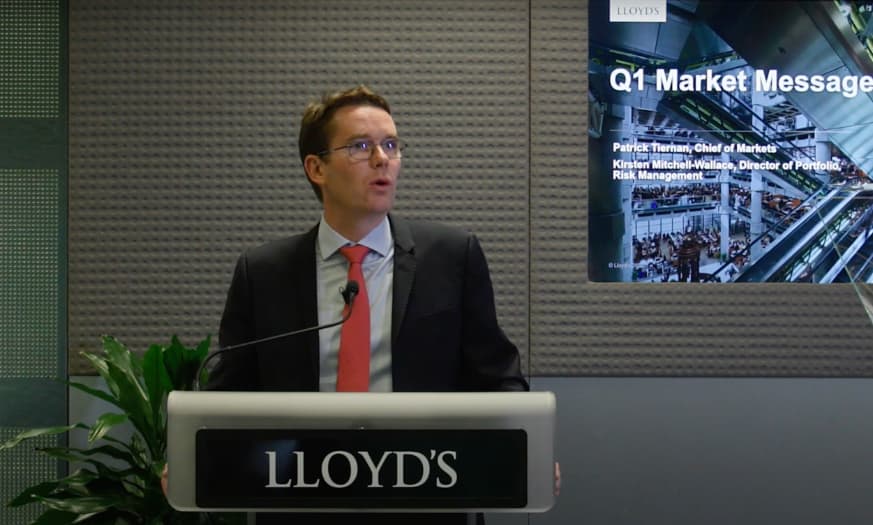
The Lloyd’s insurance and reinsurance market is seeing an uptick in reinsurance submissions in the first-quarter of 2023, as syndicates and participants work through the impacts of the January renewals, according to Chief of Markets Patrick Tiernan.
At the same time, Tiernan noted that, only those syndicates that demonstrate they can manage the cycle profitably and sustain that discipline will be able to go forward.
Speaking this morning during his delivery of a Q1 message to the market, Tiernan explained that while the January reinsurance renewals were not as dislocated as expected, the fall-out continues, in the form of more reinsurance submissions running into Q1.
Discussing market conditions, Tiernan said, “Maintaining underwriting discipline, backed by pricing and analytics is vital to ensure that Lloyds is well positioned to deal with the short and long term uncertainty we continue to face globally.
“As a market we have seen five of the last six years, where the major claim ratio was above our 10 year average.
“So as we look to the future, we do so in the knowledge of fresh challenges, now amplified by changes to reinsurance and retro availability.”
Moving on to discuss catastrophe risk, an area Lloyd’s has placed significant focus and also restricted underperformers in recent years, Tiernan explained that the focus on sustainable performance will continue in 2023.
“Let me be clear, our view has not changed,” Tiernan said. “The market has done a very good job to gain control of the balance-sheet, to gain control of the attritional and vertical losses in peak cat, and now we need to expand this rigour to manage the sideways and emerging risks. This cannot be achieved by price alone.”
“So only firms who are managing the cycle well and have achieved sustained profitability and can prove to Lloyds that they can maintain this discipline, can go forward in these difficult conditions,” he added.
He highlighted the way Lloyd’s has worked with players that have demonstrated their discipline and ability to manage the cycle, as the ones allowed to write more cat and other lines business at the start of the year.
“I want to acknowledge the way the vast majority of you gave due consideration to these factors during the planning phase and built in a level of prudence to help navigate through the 1/1 reinsurance cycle.
“We sought to return the favour with pragmatic support at speed to enable well-positioned syndicates to capitalise on the market opportunities,” he explained.
He continued to discuss the reinsurance renewals, saying, “The worst fears of reinsurance market dysfunction did not materialise, and so resubmission activity was low at the turn of the year.”
But went on to explain that the fall-out from the renewals continues to be seen, saying, “However, over the last few weeks, Lloyd’s has seen an uptick in reinsurance submissions as syndicates have worked through the impacts of their 1/1 renewals.”
On this, Tiernan noted that, “While the balance of resubmissions has had a positive weighting, my expectation is that in the aggregate, the impact will not be material in terms of GWP.
“But I do expect to see a change in the shape of the 2023 underwriting year arising from four key factors.”
“Firstly, the risk return analysis by property underwriters on the relative attractiveness of well-defined layers, versus more difficult to protect low-level binders will change the portfolio. Secondly, changing dynamics in certain D&O and cyber markets are driving underwriters to reevaluate their plans. Thirdly, lessons learned and reinsurer led pressure on terms and conditions that result in more stress in the tail of war or sanction impacted specialty lines. Finally, on the positive side, opportunities created by policy or economic changes, particularly in the US and Europe,” he explained.
Going forwards, Lloyd’s will maintain a focus on the class specific challenges that the market is facing, Tiernan said.
Some syndicates will not have been able to buy the reinsurance they really wanted at 1/1 and so may be rearranging things now, while buyers are also coming to market to top-up areas of towers that could not be served at the renewals.
At the same time, there will also be some reinsurance submissions related to the late nature of the renewals, where books still need to be protected for the remainder of the year-ahead.
Tiernan’s comments show that Lloyd’s is keeping on top of such developments, while also being aware that the shape of its book continues to morph, as the dust from a challenging reinsurance renewal continues to settle.