An increase in the supply of reinsurance at the January 1st, 2024, renewals, led to a relatively stable and orderly renewal with risk-adjusted pricing witnessing flat changes overall, as global risk-adjusted property catastrophe rates-on-line rose by an average of 3%, reports broker Howden.
Since the January 2023 renewals, market conditions have improved with Howden highlighting that this year’s reinsurance renewal took place in an environment of more favourable supply dynamics, while underwriting discipline remained.
Loss expectation were re-set throughout 2023 and alongside new macroeconomic and geopolitical realities, drove nuanced conditions across the insurance and reinsurance market.
Howden’s renewal report at 1.1 2024, A New World, shows that overall, risk-adjusted pricing saw flat changes, with any significant variation by territory or line of business informed by loss experience.
In line with last year, reinsurance capacity for frequency protection was at a premium, but competition higher up towers brought improved outcomes, says the broker. At the same time, terms and the scope of coverage were a core focus in 2024, which led to an improved concurrency overall.
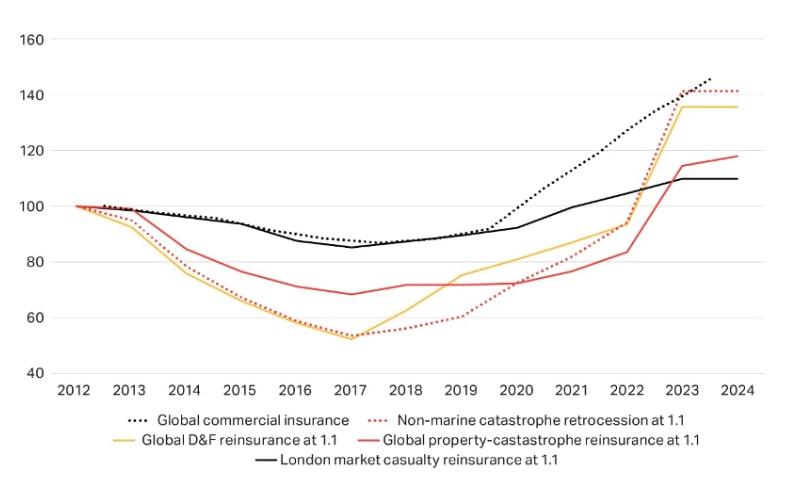
In terms of rates movements, Howden reports that global risk-adjusted property catastrophe rates-on-line increased by 3% on average at 1.1 2024, which is a steep decline from the 37% increase recorded in 2023. The report states that greater appetite from most markets meant supply was able to meet demand to a degree that was lacking last year.
According to Howden, the rebound in the insurance-linked securities (ILS) market was an important factor as competition rose for higher-attaching layers of programmes, which ultimately encouraged new sponsors to enter the market.
In Europe specifically, Howden reports that loss experience and inflation shaped the renewals. Again, more favourable supply dynamics helped to moderate overall price rises to low to mid-single-digits. Efforts to restructure programmes were extended at 1.1 2024 to countries that avoided adjustments and made sizeable recoveries in 2023, including Italy, Turkey, and Slovenia, where double-digit risk-adjusted price increases were typical.
In the US, supply dynamics also improved at 1.1 2024, with Howden noting that reinsurers were willing to support terms and pricing levels broadly aligned to those established at 1.1 2023. Capacity was still restricted for lower levels of programmes, but greater competition higher up resulted in more attractive pricing for mid-to-top layer risk.
In the retrocession market, Howden highlights the absence of major losses in 2023, favourable development for Hurricane Ian and increased capital inflows towards the end of 2023, all of which led to a stable retro renewal at 1.1 2024. Risk-adjusted retro catastrophe excess-of-loss rates-on-line were flat at 1.1. Low-attaching occurrence layers and aggregate covers continued to experience a lack of supply, whilst strong competition further up programmes resulted in favourable outcomes for cedents. Strong investor appetite saw catastrophe bond pricing fall in the 10% range and remain at attractive levels for both buyers and seller, says Howden.
In the Global direct and facultative (D&F) market, demand for catastrophe cover remained robust at 1.1 2024, driven by higher rates, elevated insured valuations on original business and the need for additional limit. Rate movement in 2024 was flat on a risk-adjusted basis, although the broker notes that a cumulative increase of 160% since 2017 keeps pricing levels close to where they were last year.
In the casualty market, Howden reports that the 1.1 2024 renewals were characterised by sufficient capacity and market discipline. London market casualty reinsurance excess-of-loss rates remained stable at January 1st, 2024. Howden notes that outlier outcomes were driven by individual account performance rather than overriding market sentiment.
Below, you can see Howden’s pricing index for primary, reinsurance, and retro markets between 2012 and 2024.
“The reinsurance market has stabilised after last year’s exceptionally challenging renewal. Reinsurers were relatively unscathed by large losses in 2023, due in part to more favourable terms and conditions, including higher risk retentions and attachment points,” said Tim Ronda, CEO, Howden Tiger.
“Returns are back at equal to, or greater than, reinsurers’ cost of capital. Activity in the lead-up to 1 January was timely and orderly, and our clients are in a better position to understand their cost of reinsurance and volatility within their retention. It seems we are in a period where stability is rewarding both clients and reinsurers,” he added.
David Howden, Founder & CEO, Howden, said: “Risks are escalating as the world lurches from one crisis to another. The value of risk transfer comes to the fore during such volatile times. This is the moment for brokers and carriers to step up and apply our intellectual and financial capital to find creative solutions that safeguard the insurability of assets exposed to a myriad of risks, including climate change, geopolitical instability and rapid technological advancements. Offering innovative products that meet clients’ changing needs is the route to long-term relevance, and new possibilities.
“Howden stands at the forefront of these efforts by applying differentiated insights and expertise to deliver pioneering solutions. With macro and geopolitical shocks fuelling uncertainty, and the risk landscape changing like never before, Howden is supporting clients by accessing new pools of capital and securing the best coverage available in the marketplace.”