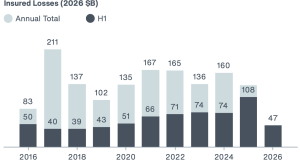
The insurance industry has essentially focused its attention on what is regarded as “primary’ perils”, which mainly involves tropical cyclones and earthquakes, according to Rob Stevenson, Senior Client Director of Moody’s RMS.
 In a recently published blog, authored by Stevenson, he highlights how secondary perils – either perils that follow on from primary events, such as floods after hurricanes, or secondary perils themselves – such as wildfires, hail, severe convective storms, are collectively starting to take a much greater share of losses.
Throughout the last decade, the catastrophe risk landscape has witnessed major changes. The insurance industry has seen a significant increase in losses from secondary perils which have also been exacerbated by factors such as exposure spread, climate change, and economic development.
What was once referred to as ’secondary’ perils have moved into the spotlight, and their financial impact on insurers and reinsurers has grown significantly.
With cat risk models having been in use for over three decades, while at the same time, computing power having grown substantially together with technological advances over recent years, Stevenson suggests that the level of granularity required to accurately model high-gradient perils like floods, severe convective storms, and wildfires has now brought secondary perils into clearer focus.
He added how this has also helped to underline the threat they pose to earnings.
Highlighting business earnings, usually these are calculated as revenues less expenses, interest, and taxes. But, for re/insurers, earnings are premiums collected on insurance policies (revenue) less claims paid out (expenses).
However, while there are other expenses to account for, including IT and human capital, the majority of the time, these tend to be much smaller and easier to plan for and predict. In contrast, outsized cat losses and subsequent claims paid out are subject to much greater volatility for re/insurers.
Stevenson stated that when firms consistently struggle to meet their cost of capital it winds up raising concern among shareholders and board members.
He explained how executives will question whether a firm understands both large-scale catastrophes and these risks that will erode year-over-year earnings, which are often driven by smaller and more frequent events from secondary perils.
As a result, this erosion of earnings represents a challenge known as earnings risk; a risk which is well understood within boards, but one that is not often shared among practitioners involved in catastrophe management.
Moreover, Stevenson suggests that one of the key challenges faced by the industry when dealing with secondary perils is their representation in risk models. Because of their unpredictable and localized nature, secondary perils are constantly linked to higher levels of under-insurance or coverage gaps, which ultimately can lead to significant disparities between insured and actual losses.
This lack of comprehensive modeling can wind up resulting in a potential underestimation of losses, introducing unexpected earnings risk for re/insurers.
Another key element to note, is that secondary perils are also more vulnerable to the impact of macroeconomic changes such as increases in property exposure, inflation, and supply chain issues.
However, while a single secondary-peril-driven event should not exhaust a reinsurance program, an aggregation of events can significantly impact a reinsurer’s profitability.