U.S. primary insurer Allstate has completed the placement of its 2023-2024 Nationwide Excess Catastrophe Reinsurance Program, revealing that the top of the tower has come down slightly from the Q4 2022 update, while the cost of the program has increased year-on-year.
At $6.92 billion, the top-end of the tower has come down from the $7.01 billion of coverage announced back in February 2023, after Allstate increased coverage by $100 million in Q4 2022 via the issuance of a catastrophe bond, Sanders Re III Ltd. (Series 2022-3).
The total cost of Allstate’s property catastrophe reinsurance programs, excluding reinstatement premiums, was $219 million in Q1 2023 and $144 million in Q1 2022, so has risen amid hardening reinsurance market conditions. While the cost of the program is compared year-over-year, the adjustments in the program outlined below show the tower as at Q1 2023 compared with Q4 2022.
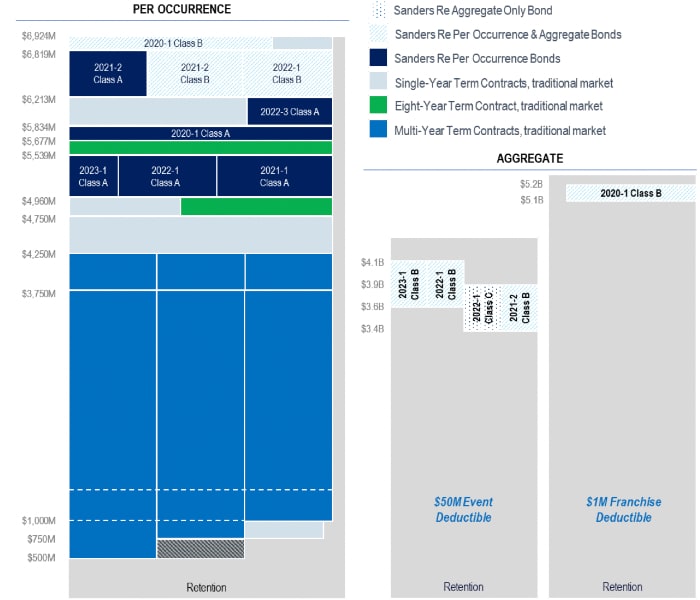
The latest tower includes five multi-year and per-occurrence excess agreements placed in the traditional reinsurance market, which together provide coverage up to $4.25 billion in excess of a $500 million retention and exhausting at $4.75 billion per loss occurrence. Two eight-year contracts, and four single-year contracts fill capacity around the multi-year and eight-year contracts, says Allstate.
Contracts providing coverage up to $4.25 billion each provide one-third of 95% of the total limit.
Between the $4.25 billion and $4.75 billion exhaustion point of this part of the program sits a new $500 million single-year contract, again 95% placed.
Additionally, new contracts effective June 1, 2023 consist of five layers and expire May 31, 2026, and include one annual contract providing $250 million of placed limit in excess of a $750 million retention, and four multi-year contracts structured with a retention of $1 billion.
At the same time, Allstate has reset its catastrophe bond transactions with the lowest on the tower now attaching at $4.96 billion compared with at $4.5 billion previously.
The retentions across different layers of the program has also changed in places, although it’s somewhat challenging from the information provided to figure out the exact amounts.
However, what is clear is that the large retention at the top of the previous tower has disappeared, with the higher attaching cat bonds now extending to the top of the tower, alongside a slice of single-year protection, and the 5% retention that runs up the side of the tower.
The retention at the bottom of the tower is also somewhat different, and now extends above the $500 million for a portion of the tower, although it is unclear by exactly how much.
So, in terms of the per-occurrence program, the core multi-year contracts still attach at $500 million and exhaust at $4.25 billion, but above this now sits the $500 million single-year secured from the traditional market, whereas in Q4 2022 above the $4.25 billion was a $250 million eight year contract.
In terms of the aggregate part of the program, which is all cat bonds, the attachment point has again been raised with the lowest now attaching at $3.4 billion of losses up to $4.1 billion, compared with an attachment point of $2.7 billion exhausting at $3.5 billion previously. So, while the top-end of the aggregate tower has been extended, the higher attachment point for these bonds means that Allstate will retain more of the losses.
Given that the structure of the tower has changed somewhat, including retentions for different layers, new single-year contracts and the higher attaching cat bonds, it’s difficult to tell if more limit has been secured for the year ahead. But it’s safe to say that the top-end of the main per-occurrence tower has come down slightly, while the cost of the program has risen.
You can see Allstate’s 2023-2024 Nationwide Excess Catastrophe Reinsurance Program below.
Allstate is currently back in the catastrophe bond market with a new Florida focused cat bond under its Sanders Re program of deals.