Hail damage is predominantly driving the loss trend for severe convective storms (SCS) in the United States, with the peril driving 50 to 80% loss claims any given year, Gallagher Re’s Steve Bowen has said.
 The Chief Science Officer of reinsurance broker Gallagher Re, explained in a LinkedIn post that 2023 has seen “relentless” SCS activity, with insured losses rising commensurately with this activity.
According to Bowen, US SCS insurance industry loss tally is nearing $40bn already this year and could become the third most costly year for the insurance and reinsurance industry – joining 2011 ($40bn) and 2020 ($44bn).
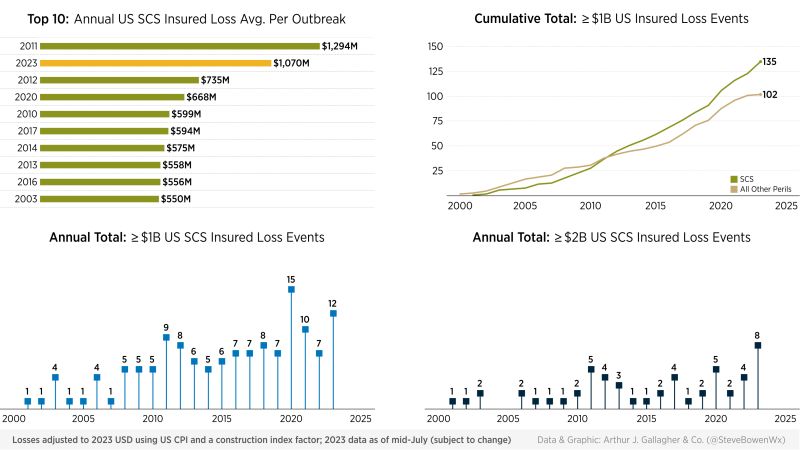
Through the middle of July, the per-outbreak average cost for insurers was already above $1bn, with only 2011 having seen a higher per-outbreak cost at $1.3bn.
“There have already been a record 8 multi-billion-dollar US SCS insured events. Since 2000, the SCS peril has accounted for 135 billion-dollar-plus insured losses in the US. All other perils combined only tally to 102,” Bowen highlighted.
Data shows that already 2023 has seen eight individual $2bn plus insured SCS loss events in 2023, the highest number on record, while there have been 12 individual $1bn plus events, the second-highest seen.
“The bucketing of perils into “primary” vs “secondary” silos feels more obsolete by the day. We have enough examples of individual “secondary” peril events leading to “primary” level losses to showcase that any peril can lead to extensive losses,” Bowen noted.
Adding: “The other plain truth? Hail is predominantly driving the loss trend. Not tornadoes. Hail may not be as photogenic as tornadoes and not get the prime media coverage, but it absolutely should be getting properly described as the major risk it continues to pose. In any given year, hail drives 50 to 80% of SCS loss claims.”
He further explained that, “There is no question that growing exposure footprints has raised the loss potential regardless of whatever enhancements climate change will bring.”
According to Bowen, SCS still does not get the respect that it deserves. He concluded: “It’s bringing very real challenges to large US national carriers and smaller regional carriers. The prospect of a $10B SCS year was a big deal in 2008. We annually average nearly $30B today.
“The definition of “normal” continues to evolve, and we must not get comfortable in these skyrocketing costs. There are construction practices and products available to better protect against these risks.
“We’ll never bring risk to zero, but any meaningful mitigation efforts must be considered and incentivized.”