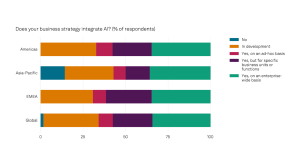
The Lloyd’s Market Association (LMA), in collaboration with Barnett Waddingham and the LMA Risk Next Generation Committee, has published a survey finding that artificial intelligence (AI) is now used across much of the Lloyd’s market, with 93% of firms having or developing formal AI frameworks to support adoption.
 The survey is based on 39 responses from firms representing over 60% of Lloyd’s market stamp capacity. Findings show a significant shift over the past 12 months, with AI adoption moving from limited experimentation to more widespread early-stage deployment.
In 2025, around half of firms reported limited or no AI implementation. Twelve months on, AI is now widely used across the market, with 93% of respondents reporting that they have or are developing an AI framework—72% already in place and 21% in development.
This marks a transition towards more structured, governed adoption, with firms prioritising oversight, accountability and risk management ahead of large-scale deployment.
The survey noted that the acceleration in AI adoption is primarily driven by generative AI applications such as ChatGPT and Microsoft Copilot, alongside internal productivity use cases including summarisation, reporting, and data processing. However, these applications remain largely focused on efficiency gains, with limited deployment in core underwriting, pricing, and claims decision making.
Findings also showed that 44% of firms assign AI governance to the Chief Technology Officer, while 33% have established dedicated AI governance committees.
Data privacy, cybersecurity, and third-party risk are now the leading concerns among respondents. Talent and skills gaps were also identified as a key challenge, with firms highlighting the need to build internal expertise to support effective AI adoption.
Last year’s findings highlighted concerns around regulatory uncertainty and the absence of robust AI frameworks, whereas the 2026 survey shows governance is now firmly established as a priority, with most firms implementing or developing structured approaches.
Firms are embedding policies, oversight structures, and controls ahead of scaled deployment, reflecting a more deliberate and risk-aware approach to AI adoption.
Human oversight also remains central to decision making, with over 60% of firms requiring mandatory review of AI-generated outputs to ensure AI is used to enhance, rather than replace, expert judgement.
While progress has been made, accountability and regulatory integration remain areas of ongoing development.
The findings also point to a clear shift in how firms perceive AI-related risks. In 2025, data security and privacy were not consistently ranked among the top priorities. In contrast, in 2026, data privacy, cybersecurity, and third-party risk have emerged as some of the most prominent concerns across the Lloyd’s market.
This reflects growing awareness of the risks associated with scaling AI, particularly around data handling, third-party dependencies, and system security.
Around one in four firms still rely on general third-party risk management frameworks rather than AI-specific provisions.
Concerns around data quality, bias, and the reliability of AI outputs remain ongoing, highlighting the need for continued investment in validation, testing, and assurance as use cases evolve.
Sanjiv Sharma, Head of Actuarial and Exposure Management at the Lloyd’s Market Association, said, “AI adoption across the Lloyd’s market has accelerated quickly over the past 12 months, but what’s encouraging is that governance is being built alongside it, rather than after the fact, with over 93% of those surveyed having a framework in place or being developed. What the survey clearly highlights is that the market is still early in its journey, but the foundations for responsible adoption are clearly being put in place.
“There is no clear consensus across the market on where responsibility for AI governance should sit, with firms adopting a range of approaches across technology, risk and compliance functions.”
Wan Heah, Partner and Head of General Insurance at Barnett Waddingham, added, “The market is moving past experimentation and towards a more disciplined use of AI, with governance, data protection and validation now firmly in focus. The real test is ensuring these frameworks keep pace as AI applications become more complex.
“There is no single blueprint for AI governance. Firms need to strike a careful balance between risk and opportunity and put in place practical, robust risk management strategies to support responsible adoption.”