

Preliminary forecasts from meteorological experts suggest that the Atlantic will experience average levels of hurricane activity in 2019, although El Niño may add some uncertainty to the outlook.
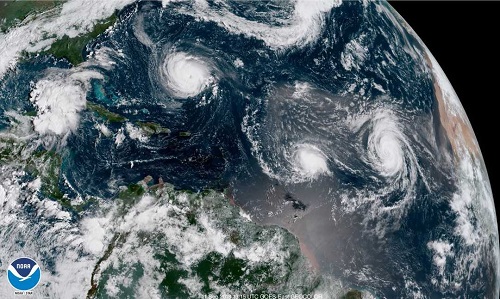
Hurricane Florence approaching the U.S east coast on Sep 15th 2018, followed by a tropical storm and hurricane. Source: NOAA
Analysis from Tropical Storm Risk (TSR), a re/insurance industry-backed tropical weather research group, predicts that the 2019 Atlantic hurricane season will be about 80% of normal, and forecasts 12 tropical storms over the year (+/- 4).
Of these storm, TSR suggested that 5 could become hurricanes and 2 could become intense hurricanes of at least Category 3.
These figures would be slightly below the average hurricane levels experienced over the last ten years, TSR noted, but roughly in line with the long-term average.
At present, TSR anticipates that trade wind speed will be slightly stronger than normal during the 2019 hurricane season due to a continuation of weak El Niño conditions, which it believes will have a suppressing effect on Atlantic hurricane activity.
Similarly, the tropical forecasting team at Colorado State University forecast an accumulated cyclone energy (ACE) of around 80 for the 2019 season, which could entail up to 11 named tropical storms, five hurricanes and two major hurricanes.
The prediction is based on the assumption of ongoing El Niño conditions, but researchers noted that variance in these conditions could have a major impact on levels of storm activity.
For example, if an El Niño event does not occur and the Atlantic Multidecadal Oscillation (AMO) is above average, the University team estimates that the season could reach an ACE of 130, resulting in more storms and hurricanes.
Both organisations stipulated that their predictions were based on extremely premature data and could be subject to considerable change as the year plays out.
Nevertheless, given the magnitude of the impact of the 2017 and 2018 hurricane seasons on the global insurance and reinsurance industries, it seems prudent for the market to pay attention even to these earliest forecasts.