Dedicated reinsurance capital is expected to increase further in 2026, as reinsurers continue to benefit from underwriting profits, investment returns and growing participation from third-party capital, according to AM Best, the global insurance credit rating agency, and reinsurance broker Guy Carpenter.
In its report Global Reinsurance at an Inflection Point: Can Discipline Survive the Temptation of Record Capital?, AM Best said the continued expansion of dedicated capital has largely been driven by existing market participants retaining earnings rather than by a significant wave of new reinsurers entering the market.
This marks a difference from previous hard-market cycles, when newly established reinsurers entered the sector and sought to build market share by offering cover at lower prices. The absence of a comparable influx of new companies has helped limit competitive pressures, according to the rating agency.
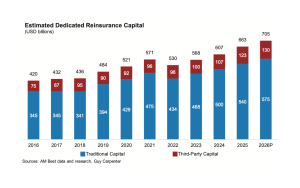
AM Best and Guy Carpenter, the reinsurance broking arm of Marsh, project total dedicated reinsurance capital will reach $705 billion by the end of 2026, up from $663 billion at the end of last year. Traditional capital is forecast to grow from $540 billion in 2025 to $575 billion in 2026, while third-party capital is projected to reach a record $130 billion.
AM Best noted that capital generated within established reinsurers generally enters the market at a slower pace than capital raised by new entrants. It can also be allocated across a wider range of underwriting activities, rather than being concentrated in a particular segment of the reinsurance market.
The rating agency said the key issue now is whether this pattern will continue as capital reaches increasingly high levels. Reinsurers have more options for deploying capital than they did in earlier market cycles, partly because many of the largest groups have expanded their operations beyond traditional reinsurance.
According to AM Best, leading reinsurers now commonly have diversified businesses spanning primary insurance, specialty underwriting and alternative capital. This gives management teams a number of ways to deploy additional capacity, including acquisitions, expansion into other areas of the business and increased distributions to shareholders.
AM Best said these options could help preserve pricing discipline by reducing the incentive for reinsurers to put excess capital directly into property catastrophe reinsurance. Capital accumulation therefore does not necessarily have to translate into additional capacity in the areas where pricing is most sensitive.
At the same time, AM Best cautioned that the balance could change if competitive pressures become stronger. If reinsurers increasingly compete for business and prices fall materially, the market could again reach a point where rates do not adequately reflect risk.
For AM Best, the current market provides an important test of whether the reinsurance sector has undergone a lasting structural change. Maintaining underwriting discipline despite historically high levels of capital would indicate that established reinsurers are managing capacity differently from previous cycles. A deterioration in discipline, by contrast, could demonstrate that growing capital continues to create pressure to compete for additional business.
For further information on the report, please refer to our article here.