Inaugural full catastrophe bond issuances from insurers and reinsurers in 2020, combined with maiden deals from the largest municipal utility in the U.S. and Google’s parent, Alphabet, Inc., contributed to a record year for the catastrophe bond and related insurance-linked securities (ILS) market.
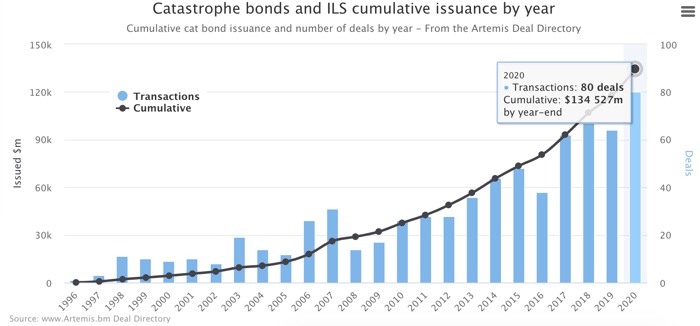
 The Artemis Deal Directory and Q4 2020 cat bond and ILS market report shows that, overall, a record 80 transactions came to market in 2020, beating the previous high of 67 deals recorded in 2018.
While the majority of sponsors that entered the market in 2020 had featured previously, including the likes of Swiss Re, Liberty Mutual, AXIS Capital, USAA, Allianz, and TWIA, among others, Artemis’ data shows that 10 new players featured in the period, six of which came to market in the fourth-quarter.
The first new sponsor entered in January of 2020. Sponsored by funds managed by Bayview Asset Management, LLC, the $225 million Sierra Ltd. (Series 2019-1) transaction provided a source of earthquake risk transfer and insurance to the fund.
Later in the month, Markel Bermuda Limited sponsored its first deal, a $100 million Stratosphere Re Ltd. (Series 2020-1) transaction designed to provide reinsurance protection for a range of U.S. natural catastrophe perils, covering some of the tail risk State National retains through its work with ILS manager Nephila.
February through May, a period which endured a slight but fleeting slowdown as a result of the COVID-19 pandemic, a flurry of traditional 144A, private cat bond issuances and mortgage ILS deals all came from repeat or unknown sponsors.
In June, Fidelis Insurance Holdings Limited, the specialty insurer and reinsurer launched by Richard Brindle, sponsored its Herbie Re Ltd. (Series 2020-1) transaction. Fidelis’ first entry into the cat bond market brought $125 million of U.S. named storm and U.S. earthquake risk to market and after the success of this deal, Fidelis returned later in the year with a larger, $275 million Herbie Re Ltd. (Series 2020-2) transaction.
The following month, Stephen Catlin’s Convex Group sponsored its first transaction, a $300 million Hypatia Ltd. (Series 2020-1) deal exposed to losses from U.S. named storms, including Puerto Rico, D.C and the US Virgin Islands, as well as both U.S. and Canadian earthquake risks.
Interestingly, new market entrants in 2020 didn’t just focus on catastrophe risks. At the start of the fourth-quarter, Minnesota Life Insurance Company, a life insurance subsidiary of the Securian Financial Group, looked to the capital markets for additional reinsurance for its life book. The result was La Vie Re Limited (Series 2020-1), a $100 million transaction covering extreme mortality.
Later in the fourth-quarter, Allied World Assurance Company sponsored its first catastrophe bond with a $210 million 2001 CAT Re Ltd. (Series 2020-1) transaction, providing the insurer and its subsidiaries with protection against losses from U.S named storm and Canada earthquake, U.S. severe thunderstorm, and European windstorm risks.
At the start of December, a new corporate sponsor in Alphabet, Inc., the parent of Google, brought a combined $332.5 million of California earthquake risk to market. Both Phoenician Re Ltd. (Series 2020-1) and Phoenician Re Ltd. (Series 2020-2) also cover damages to Alphabet property caused by an earthquake that occurs outside of the state.
Around the time of the Alphabet deals, the Los Angeles Department of Water and Power (LADWP), the largest municipal utility operating in the U.S., sponsored the first wildfire catastrophe bond to benefit a municipal utility. Although sized at just $50 million, Power Protective Re Ltd. (Series 2020-1) is a novel transaction, providing the sponsor with coverage against wildfire risks in the region of California where it operates.
The final month of the year also saw specialty insurer and reinsurer Brit Ltd. sponsor its first full catastrophe bond, having previously entered into a three-year catastrophe swap contract with Fremantle Limited in 2007. For its first full cat bond, Brit leveraged its UK domiciled protected cell company, Sussex Capital UK PCC Limited as the issuer, providing it with multi-year protection against certain losses from U.S. named storms and U.S. earthquakes.
The final new sponsor of 2020 and the very last deal issued in the most active year on record, came from Bermuda-based re/insurer Hamilton Insurance Group. The company’s first 144A catastrophe bond transaction, Easton Re Pte. Ltd. (Series 2020-1), provides Hamilton Re, the firm’s reinsurance arm, with $150 million of retrocession coverage for losses from U.S. named storms and U.S. earthquakes.
Combined, new market entrants sponsored 12 transactions comprised of 16 tranches of notes in 2020, resulting in almost $2.2 billion of new risk capital. With annual issuance of $16.4 billion, this means that new sponsors accounted for more than 13% of issuance in 2020.
So, it’s clear that throughout the second-half of 2020, conditions were favourable for new sponsors to enter the catastrophe bond market. The arrival of new sponsors, coupled with a return to the market after a hiatus for others, might well be a story of relative value as both reinsurance and retro markets hardened.
Furthermore, many of the factors driving current market conditions have persisted into 2021, so there’s potential for this year to be another very active period for the catastrophe bond and ILS marketplace.
Back in December, analysts at Fitch Ratings stated that in order for the cat bond market to expand and be more dynamic, a constant flow of new sponsors is required.
The below chart, which is based on data from the Artemis Deal Directory, shows cumulative cat bond and ILS issuance since 1996, and also the number of transactions issued each year.