Property Claim Services (PCS), a Verisk business, is currently looking at an insurance industry loss of between US $600 million and $1 billion from the South Africa riots, PCS Head Tom Johansmeyer has told us, although the ultimate cost is still dependent on a number of variables.
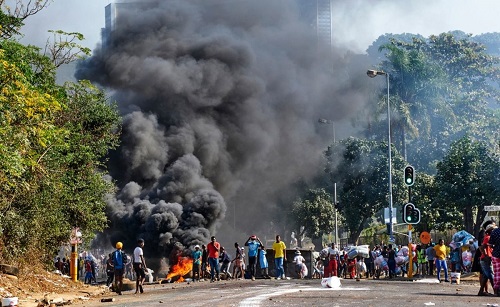
Source: Andre Swart/AP Photo
This range is based on reports from state-owned insurer Sasria, which covers all political violence risks in the country, and which has put forward an industry-wide loss figure of roughly 12 billion rand (~$830 million).
However, PCS believes there could be enough additional losses to bring the overall cost closer to $1 billion, although it is unlikely to move to this level without further upward development in energy/refinery losses, Johansmeyer says.
Unrest began in South Africa on July 8th after former President Jacob Zuma was jailed for contempt of court, triggering riots and looting within Zuma’s home province of KwaZulu-Natal.
In the following days, the crisis spread out to other regions, including Johannesburg and surrounding areas in the Gauteng province, prompting the government to deploy 25,000 troops.
Costs will likely centre around the extensive damage to more than 161 malls and shopping centres, as well as the hundreds of millions in stolen goods.
So far, at least 215 people have died and more than 2,500 have been arrested on charges including theft and vandalism, and there are now fears of local food and fuel shortages in the aftermath.
Speaking to Reinsurance News, Johansmeyer noted that PCS’s loss range remains “realistic and reasonably cautious” given that the industry is still receiving inbound data from the event, and given that PCS does not usually report on catastrophes in South Africa.
Indeed, it’s important to stress that many uncertainties still surround the cost of the riots, in particular around Sasria’s coverage and its reinsurance program.
For instance, reports suggest that Sasria may only cover customers up to a threshold of 500 million rand (~$34 million), which could leave larger companies out of pocket if they have suffered significant damages.
“It’s currently too soon to tell what those losses will look like, which represents an important reason or the variability in loss forecasts being shared with PCS,” Johansmeyer said, referring to possible energy losses.
“If it does reach US$1 billion, it would be the third SRCC event to do so in as many years – following the 2019 SRCC event in Chile and the 2020 SRCC loss event in the United States. Even if the event in South Africa remains below US$1 billion, it remains an important and significant SRCC event for the third year in a row.”
“Large SRCC catastrophe events have shared certain characteristics since the 2016 event designated by PCS in Southeastern Turkey. In particular, all four (Turkey, Chile, United States, and South Africa) have had significant portions of the industry-wide loss coming from a concentration of large risk losses. For Chile and the United States, it was the retail sector. For Turkey, it was energy, and that appears to be the case for South Africa as well,” Johansmeyer explained.
“PCS has been told by several of our data sources that retail is generally under-insured in South Africa, which is why the industry loss should evolve differently from what we saw in Chile and the United States. However, we note the similarities with the PCS Turkey event we designated five years ago.”