Brisbane headquartered insurer Suncorp has adjusted its reinsurance program structure for the 2024 fiscal year in light of material market hardening, reducing the top of the tower by $400 million at the same time as increasing the retention by $100 million, and opting against the renewal of its aggregate excess of loss (XoL) cover.
The insurer says that the hardening reinsurance market results in “increased reinsurance premiums and increased risk retention for FY24,” which impacts both its natural hazard allowance and the level of capital the group needs to hold.
For FY24, Suncorp’s core catastrophe reinsurance program covers its home, motor, and commercial property portfolios across Australia and New Zealand.
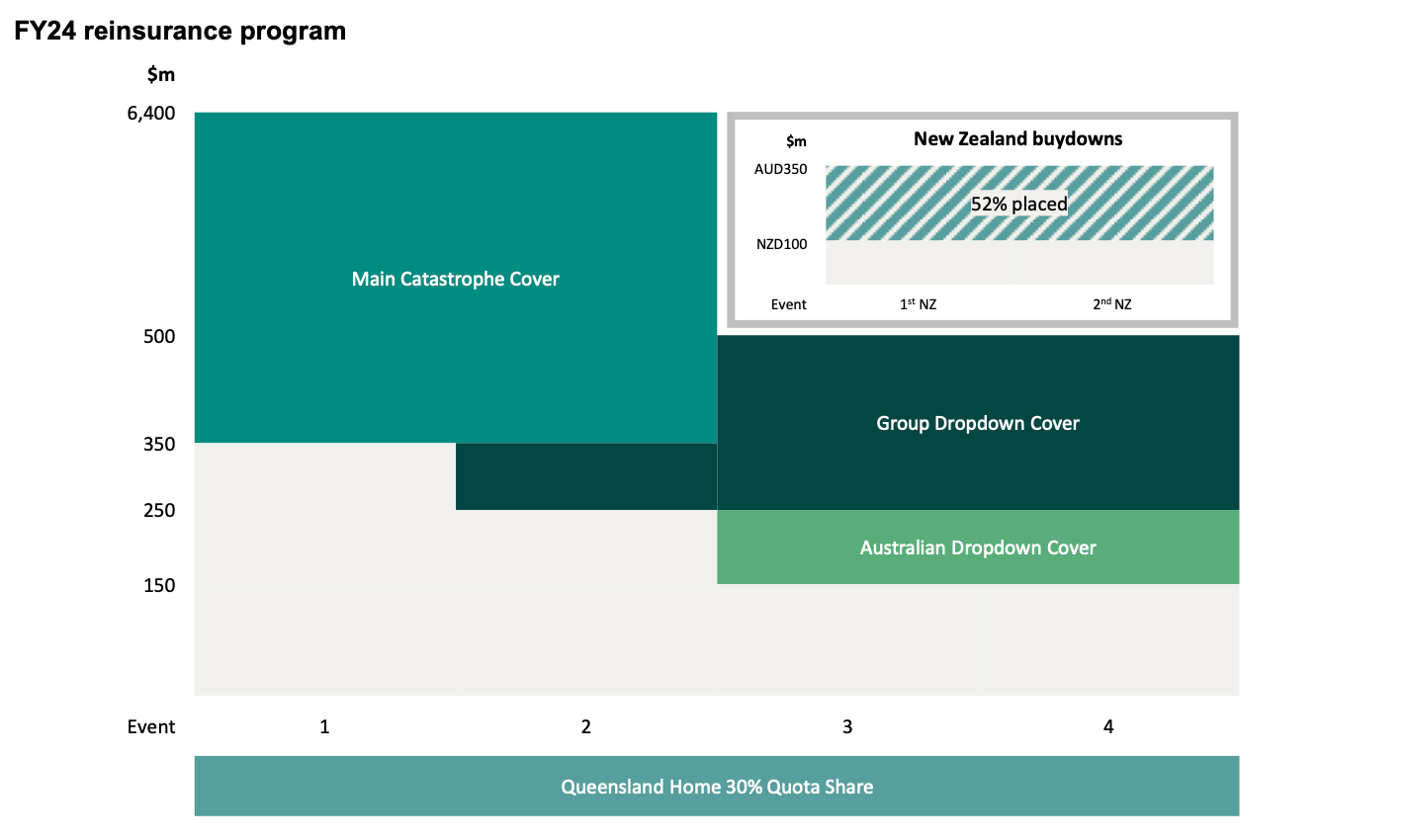
For the year ahead, the program provides protection for losses between $350 million and $6.4 billion (including one full prepaid reinstatement), compared with a maximum retention of $250 million and losses up to $6.8 billion in FY23. The $350 million retention is for a first large event and the retention for a second large event is $250 million.
In fact, the second, third, and fourth event retention has been lowered to $250 million via the purchase of group dropdown covers. In Australia, a dropdown program was also placed at the renewal which reduces the third and fourth event retention for events to $150 million.
In New Zealand, buydown (including a prepaid reinstatement) has only been 52% placed to provide protection between NZ$100 million and the Group’s maximum $350 million event retention. The insurer explains that placing the remaining 48% of this slice of coverage “was not economically viable”.
The higher retention, explains Suncorp, is mostly a result of higher reinsurance costs in the aftermath of the Auckland floods and Cyclone Gabrielle that occurred during FY23.
Although the top of the tower has come down to $6.4 billion, this is still above the Australia and New Zealand regulatory requirements.
According to Suncorp, as well as the hard market, the reduction is also a reflection of its entry into the Australian Cyclone Reinsurance Pool, and greater coverage from Toka Tū Ake EQC in New Zealand.
In a further signal of the hardening reinsurance market, Suncorp has decided not to renew its aggregate XoL cover for FY24.
Although it has renewed its quota share arrangement, ceding 30% from the Queensland home insurance book.
“We continue to see a significant reassessment of risk by our reinsurance partners, which reflects elevated natural hazard activity in recent years both globally and in Australia and New Zealand. This, combined with broader inflationary pressures across the economy, continues to impact the cost of reinsurance across the industry,” said Suncorp’s Chief Executive Officer (CEO), Steve Johnston. “This renewal again underscores the challenges facing the insurance industry in Australia and New Zealand. If the proposed sale of Suncorp Bank to ANZ is approved, Suncorp would become a dedicated insurer at a time when the value of insurance to the economy and the public has never been greater.”
While Suncorp explored a number of other forms of reinsurance, including a whole account quota share, Johnston added that the protection secured “provides the best outcome, balancing optimal returns with an acceptable level of volatility.”
You can see Suncorp’s FY24 reinsurance program below:
All in all, Suncorp anticipates the combined cost of its FY24 catastrophe reinsurance premiums and the natural hazard allowance to rise by around $250 million, or 12% from the previous year, reflecting the hardening market cycle and the impacts of losses in both countries in recent years.
Specifically, Suncorp expects the natural hazard allowance to rise from $1.16 billion to $1.36 billion in light of the higher retention outlined above and the inflationary claims landscape, somewhat offset by the ceding of cyclone risk to the pool in Australia.
Commenting on its natural hazard experience for FY23, Suncorp is estimating an impact of between $1.25 billion and $1.28 billion which is above the allowance of $1.16 billion.
The costliest event for the firm is expected to be the October 2022 Australia floods at a cost of $210 million, followed by the Newcastle hail event in May 2023 at up to $100 million, and then the Sydney east coast low in July 2022 at a cost of $87 million.