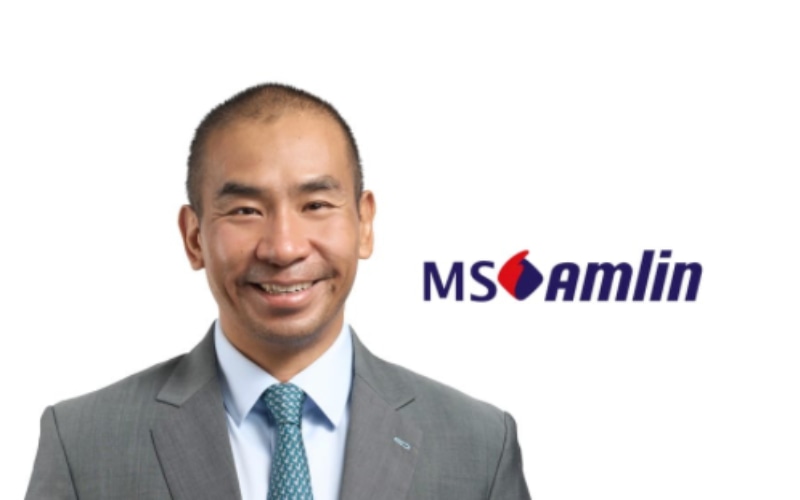
In an interview with Reinsurance News, William Ho, Chief Executive Officer of MS Amlin for Asia Pacific, affirmed that although reinsurance market dynamics in Asia have shifted in 2024, discipline is expected to persist as the company continues to innovate for clients and brokers in an ever changing landscape.
 We spoke with Ho around the 2024 Singapore International Reinsurance Conference (SIRC) to gauge his thoughts on current reinsurance market conditions in Asia and beyond as the sector heads into 2025, the potential implications of any market softening, and the main focus for MS Amlin at SIRC.
“Our message to clients throughout the conference season has remained consistent: there is a need for fair treatment at renewal from both sides. Loss impacted programmes or material exposures growth needs to be recognised by reinsurers, while the reinsured can field more enquiries of new capacity offerings to sense check their current pricing levels,” said Ho.
Beyond the renewals, Ho explained that throughout the conference season MS Amlin continued to stress that this is an important inflection point in the current market for Asia.
“As growth continues in the region, and insolvency and risk-based capital requirements change, the demand for reinsurance is set to rise across markets. The cost benefit of securing some potential savings over long-term supporters of a programme needs to be managed delicately by brokers and clients. It is crucial to choose the right long-term partners rather than focusing on any short-term gains. We anticipate that our core client base will seek MS Amlin’s capacity because we have provided value and security over time, and we will be ever present in the next evolution of this vibrant and growing region,” he said.
Amid a shift in reinsurance market dynamics in 2024, we asked Ho about the key drivers and any observations of the trends in this year’s renewals.
“While the Asia region saw some strong corrections in 2023, this has dampened in 2024 with the increased rates attracting more capacity to the region from both London and Bermuda markets. Going forward, we are likely to see this capacity reduce where the business is seen as less attractive.
“In terms of catastrophe losses, the Asia region has experienced several material events in 2024. There have been multiple strong typhoons making landfall in Taiwan, Vietnam and China. The Taiwan Hualien earthquake was the most significant loss event to impact that market in 10 years, while the Dubai floods represented the worst insured loss event to impact the MENA region to date,” said Ho.
“Globally we have recently seen insured losses exceed $100 billion for yet another year. As this is becoming the norm, we need to ensure retention and pricing adequacy remains across our portfolio to maintain a sustainable product for our clients,” he added.
Looking ahead to the 2025 renewals, Ho warned that while there seems to be an increase in available capacity as capital is flowing back into the reinsurance sector, without disciplined underwriting and positive underwriting results, that capital would easily retract again.
“While capacity is more available in both reinsurance and retro markets, it falls into two categories: some capacity is committed to the region and will remain for the long term, while more opportunistic capacity will be around for a much shorter time. Cedants need to make a conscious decision over the capacity they choose and ensure it aligns with their longer-term development plans. It would be quite risky to be overly reliant on the more short-term opportunistic capacity,” said Ho.
Of course, in terms of current market conditions, it remains to be seen exactly what happens in 2025 and whether there’s any softening. Were the cycle to shift somewhat in 2025, we asked Ho what this would mean for underwriting discipline, retentions and terms and conditions, and whether he expects reinsurers to be more willing to write aggregate covers.
“While there is speculation that there would be potential pressure on reinsurance rates, underwriting discipline will likely remain for the majority of the market. Most markets will still be bottom line driven and, in an environment where the insured losses are consistently exceeding USD 100bn globally, it would be questionable why a reinsurer would want to lower retentions or provide more frequency loss driven covers. We personally are not in a position to accommodate such actions,” he said.
To end, we asked Ho about the potential implications of market softening on the use of structured solutions and ARTs that have become more mainstream during the hard market cycle.
“Regardless of market conditions, we are always trying to be innovative for our clients and brokers to ensure we present the most suitable products that are viable and sustainable for both buyers and the sellers. While market conditions may influence available capacity, they should not dictate reinsurers’ levels of innovation.
“As we progress and develop in the Asia region and market, it is paramount we remain attuned to current climate and trends, ensuring our product offering meets clients’ and brokers’ needs, while maintaining the technical excellence required to operate a sustainable business,” explained Ho.