Reinsurance capital continues to build, creating a favourable environment for insurers but placing greater pressure on reinsurers to demonstrate the value they bring to clients, according to Laurent Rousseau, CEO of Global Capital & Advisory, and Europe and IMEA at Marsh Re.
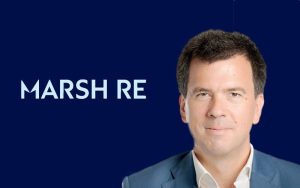 Speaking ahead of the Monte Carlo Rendez-Vous, Rousseau said the continued growth in capital was not simply a temporary feature of the market, but part of its longer-term structure. Traditional reinsurance capital is increasing alongside a faster-growing alternative capital market, with both contributing to an increasingly well-capitalised sector.
“Reinsurance capital continues to increase… It is rising on both sides of the ledger. Traditional reinsurers are building capital through strong written earnings, and alternative capital is growing faster still and continues to take a larger share of total reinsurance capital.”
Analysis by Marsh Re and AM Best projects that dedicated reinsurance capital will reach $705 billion by the end of 2026, up from $663 billion at the end of last year. Of this, traditional capital is forecast to grow from $540 billion in 2025 to $575 billion in 2026, while third-party, or alternative reinsurance capital is projected to reach a record $130 billion.
Rousseau said the strength of reinsurers’ balance sheets reflected sustained underwriting profitability as well as improving investment returns. He pointed to what is expected to be the fourth consecutive year of strong performance for the reinsurance sector in 2026, alongside high levels of excess capital and prudent aggregate reserving.
The result, according to Rousseau, is a market in which capital itself is becoming less of a point of differentiation. He said: “The reason for the growing reinsurance capital is straightforward. Traditional reinsurers are earning exceptional returns on equity, and they are earning them both from improving investment returns, and from very strong underwriting results.”
Rousseau continued: “To date, 2026 is set to be the fourth consecutive year of outstanding performance for reinsurers. Record earnings, historical levels of excess capital, and reserving positions that are, by any reasonable measure, extremely prudent on the aggregate.”
He argued that these conditions should not encourage complacency. Instead, he said, the abundance of capital should put greater emphasis on client service, relevance and the ability to provide meaningful support to insurers and their policyholders.
Rousseau said the current environment should be viewed as an opportunity for reinsurers willing to demonstrate that value. “Abundant capital should be a wake-up call, not a victory lap. It should push reinsurers to deliver more value, not less discipline, and to be materially more client-centric than the industry was when capital was scarce and clients had fewer options. Today, insurers have plentiful choices.”
He stressed that this was not an argument for reinsurers to retreat or protect existing positions. “Reinsurers who answer that question well will not simply protect a position, they will enlarge it. Their relevance will grow, and relevance to insurers who need a partner rather than a line on a placement. Relevance to insureds as well, who need coverage and response when it matters. And relevance to the broader society, which needs risk to be absorbed rather than avoided.”
Rousseau also highlighted artificial intelligence as an example of an area where the industry will need to demonstrate its ability to respond to emerging risks and opportunities.
Turning to demand for reinsurance, Rousseau said the growing supply of capital coincides with a risk environment in which insurers face a broadening range of exposures.
He said: “This increasing supply of capital represents a unique opening for insurers to adapt to their own protection to a world where risks abound. The potential for large and, in some cases, systemic risk is considerable. At the same time, the occurrence of smaller secondary perils continues to increase. We are not choosing between a severity problem and a frequency problem, we have both, and it is that combination which makes today’s risk environment so volatile.”
Rousseau described the conditions as favourable for buyers seeking additional protection or looking to use reinsurance to support growth while maintaining control of volatility and capital.
“Set our evolving risk landscape against the capital position I have just described, and the conclusion for insurers is a constructive one. For insurers, the message is straightforward: this is a buyer’s market. There is a positive environment to buy additional protection, to position at the right point in the cycle, and to support growth without sacrificing volatility management or capital adequacy.”
For Rousseau, the role of reinsurance extends beyond transferring individual risks. “Reinsurance well bought allows an insurer to support its own growth without sacrificing its volatility profile or its capital position. That is the value of reinsurance to insurers, to the economy, and society at large.”
However, Rousseau cautioned insurers against treating favourable pricing and abundant capacity as a reason to approach the market purely on a transactional basis.
He concluded: “I would add one caution, though: the best time to buy protection is when you do not feel you need it. Taking full advantage of a buyer’s market means being partnership-minded and long-term focused. A buyer’s market is not a license to be solely transactional.”