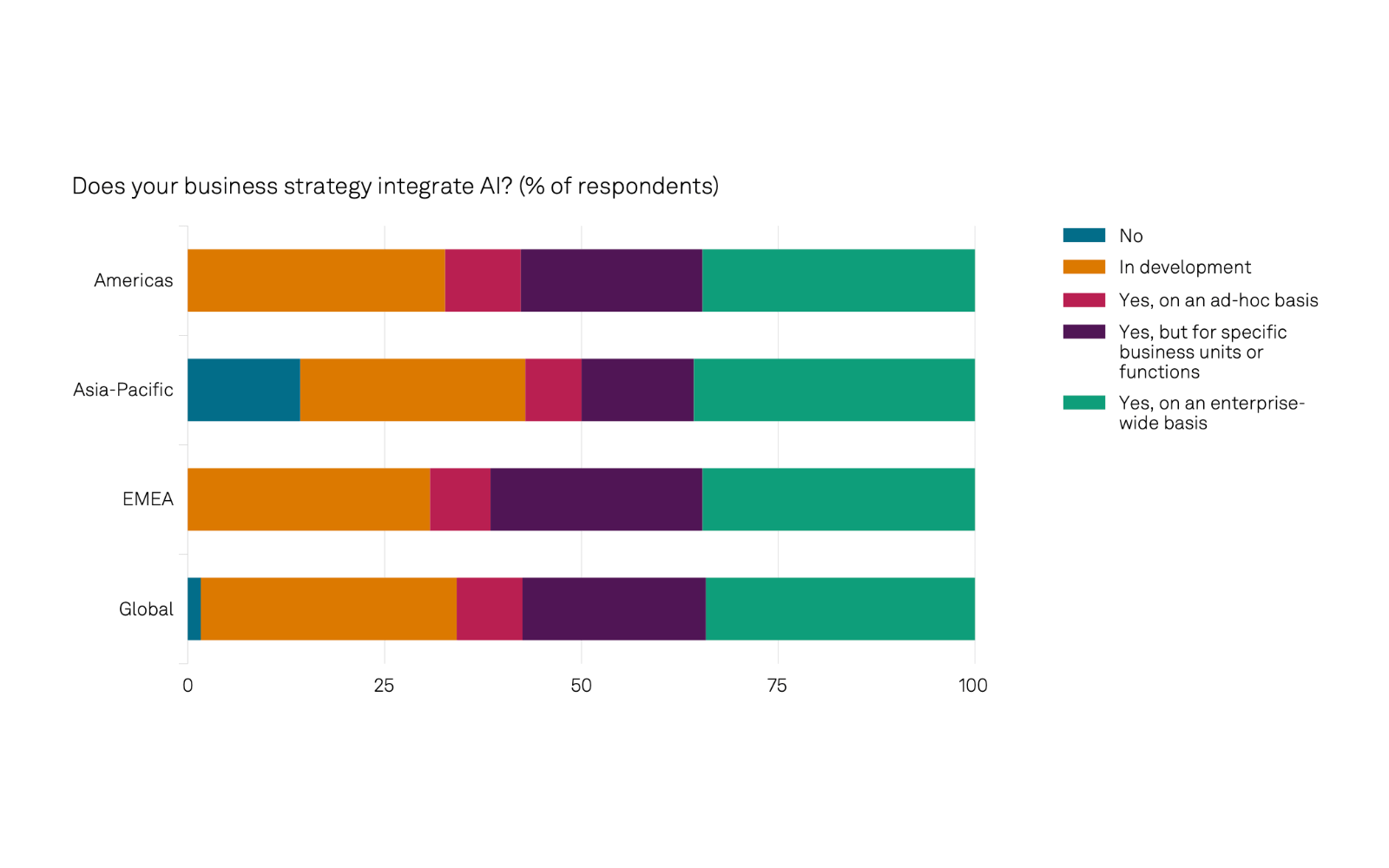
A new S&P survey found that most re/insurers have moved past the conceptual stage of AI adoption and into operational integration, though only around one-third say their AI strategy is fully integrated, with the rest still working toward enterprise-wide rollout.
“AI is increasingly transforming the insurance industry across multiple dimensions, with widespread deployment growing rapidly, driven by optimism that the technology can improve business performance,” S&P explained.
The rating agency’s survey of 121 entities globally, representing around 38% of the total assets of the re/insurers it rates, shows a shift from localised experimentation toward formal strategic integration, including at some of the largest multiline insurers and reinsurers.
S&P observed that AI is increasingly used to improve customer experience, underwriting and risk management, and claims processing, with benefits appearing earlier and more visibly than financial gains.
While AI adoption is widespread in the insurance industry, S&P noted that the differences in implementation, maturity, governance, and execution may lead to divergent outcomes on performance and credit quality.
The rating agency continued, “Although adoption has yet to directly affect S&P Global Ratings’ views on credit quality, with no AI-related rating actions in the sector to date, the potential for operational and financial gains, and associated governance and technological risks, is increasingly relevant to our credit analysis.
“While evidence of AI’s impact on profitability remains inconclusive, re/insurers suggest they anticipate that successful scaling will significantly accelerate cost savings by end-2028.”
Amid challenges such as fragmented and unstructured data, difficulty integrating AI with legacy systems, shortages of specialised AI talent, resistance to cultural change, and the challenge of scaling local pilots into enterprise-wide applications, 83% of surveyed re/insurers said they are in the early or intermediate stages of their AI journey, a finding that supports S&P’s view that an increasing number of re/insurers will expand AI use over the next three years.
“Although only 8% of surveyed re/insurers have fully integrated AI projects across their organisations, a robust pipeline of trial projects, and a low failure rate suggests adoption will expand rapidly. The speed and scale of adoption will depend on AI- related costs and gains, which are difficult to assess externally because companies often bundle them with general IT spending and process optimisation projects,” S&P added.
The rating agency continued, “While the survey suggests AI has not yet materially impacted profitability, the median re/insurer in our sample expects both efficiency gains, of 6% to 7% by 2028, and revenue improvements, of 4% to 5% by 2028.
“As implementation scales, the share of re/insurers expecting AI-related cost savings to exceed 3% rises to 80% by 2028, up from 16% in 2025. These forecast gains are reflected in projected spending, with re/insurers expecting to more than double AI-related technology budgets’ share of total costs over the next three years. Currently identified top-priority initiatives include workflow automation, AI-enabled support functions to enhance workforce productivity, improved customer solutions, and enhanced risk management.
“In our view, these initiatives could drive improvements in customer retention, distribution effectiveness, cross-selling, and risk selection.
“We remain cautious regarding the magnitude and timing of these initiatives’ effects on credit quality metrics. Moreover, given that most focus on efficiency, revenue benefits may be harder to realise and measure than targeted cost savings. Consequently, while successful adoption could enhance profitability and creditworthiness, unfruitful investments that increase cost bases remain a key risk.”
According to the rating agency, re/insurers also face adoption challenges, primarily regarding security, data privacy risks, and regulatory compliance.
These challenges, S&P said, underscore the importance of AI governance; nearly all re/insurers surveyed have established or are developing AI governance frameworks, while almost two-thirds maintain AI model inventories.
“We view this focus on governance as a signal of industry maturity and a recognition that governance weaknesses could inhibit effective AI scaling, potentially resulting in model inaccuracies, regulatory breaches, and costly remediation efforts that could negatively impact credit quality,” S&P concluded.
S&P Global Ratings analyst Andreas Lindberg commented, “The survey results show that AI is increasingly used to improve customer experience, underwriting and risk management, and claims processing, with operational benefits appearing earlier and more visibly than financial gains.
“While evidence of AI’s impact on profitability remains inconclusive, re/insurers’ survey responses suggest they anticipate that successful scaling will significantly accelerate cost savings by end-2028.”