As COVID-19 continues to profoundly influence developments in the re/insurance industry, Reinsurance News has collaborated with its ILS-focused sister-site, Artemis, to take the pulse of the market at this challenging time.
 The results of the COVID-19 Market Survey are based on responses from hundreds of market participants, of which more than half have responsibility for, or provide input to, reinsurance and retrocession buying decisions.
And while the ultimate impact of the pandemic remains uncertain, there were some clear points of consensus among respondents.
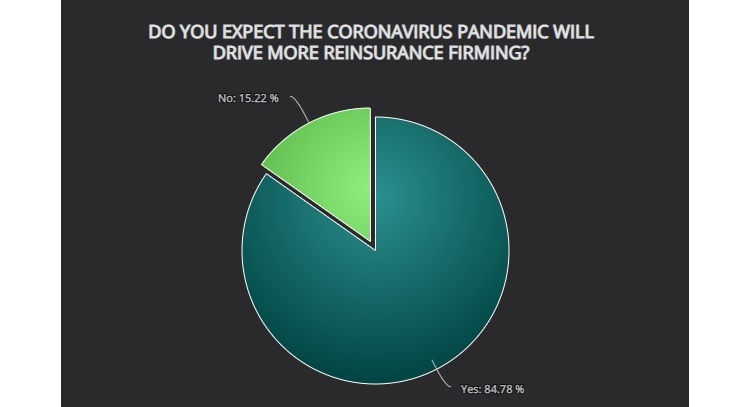
For example, nearly 85% of those who answered the survey said that they expect COVID-19 to drive more reinsurance firming.
Additionally, less than 10% of respondents reported that they expected to reduce their reinsurance or retrocession coverage following the crisis.
In contrast, roughly 60% said their appetite for reinsurance would remain about the same, while 23% said it would be slightly higher, and over 7% reported that their appetite would be much higher.
Together, these results seem to indicate that a large majority of those in the market expect reinsurance coverage to be more in demand going forward, and at a higher rate than previously.
This will no doubt offer some comfort to reinsurers who experienced another slightly disappointing renewal season, despite rate increases continuing to build some momentum.
The extent of the price firming will, however, likely depend on the scale of losses that reinsurers incur as a result of the pandemic.
Respondents to the COVID-19 Market Survey highlighted travel and cancellation & contingency lines as among those most exposed to COVID-19 losses, with investment declines and financial market volatility also likely to be major issues due to the accompanying economic slowdown.
That said, the results also show that retrocession and property and catastrophe reinsurance are considered to be the least exposed areas of the market.
With such variation between lines, the loss experience of individual firms is likely to differ considerably, although the impact on the market will still be substantial, taken in aggregate.