

Aon’s latest Global Catastrophe Recap shows that global insured losses from natural disasters reached $91 billion in the first nine months of 2026, the lowest for the period since 2019.
The figure remained well below the five-year average of $135 billion, but was slightly above the 21st-century average of $88 billion.
Global economic losses reportedly reached approximately $204 billion over the same period. That was 31% below the 21st-century average and the lowest first-nine-month total since 2015.
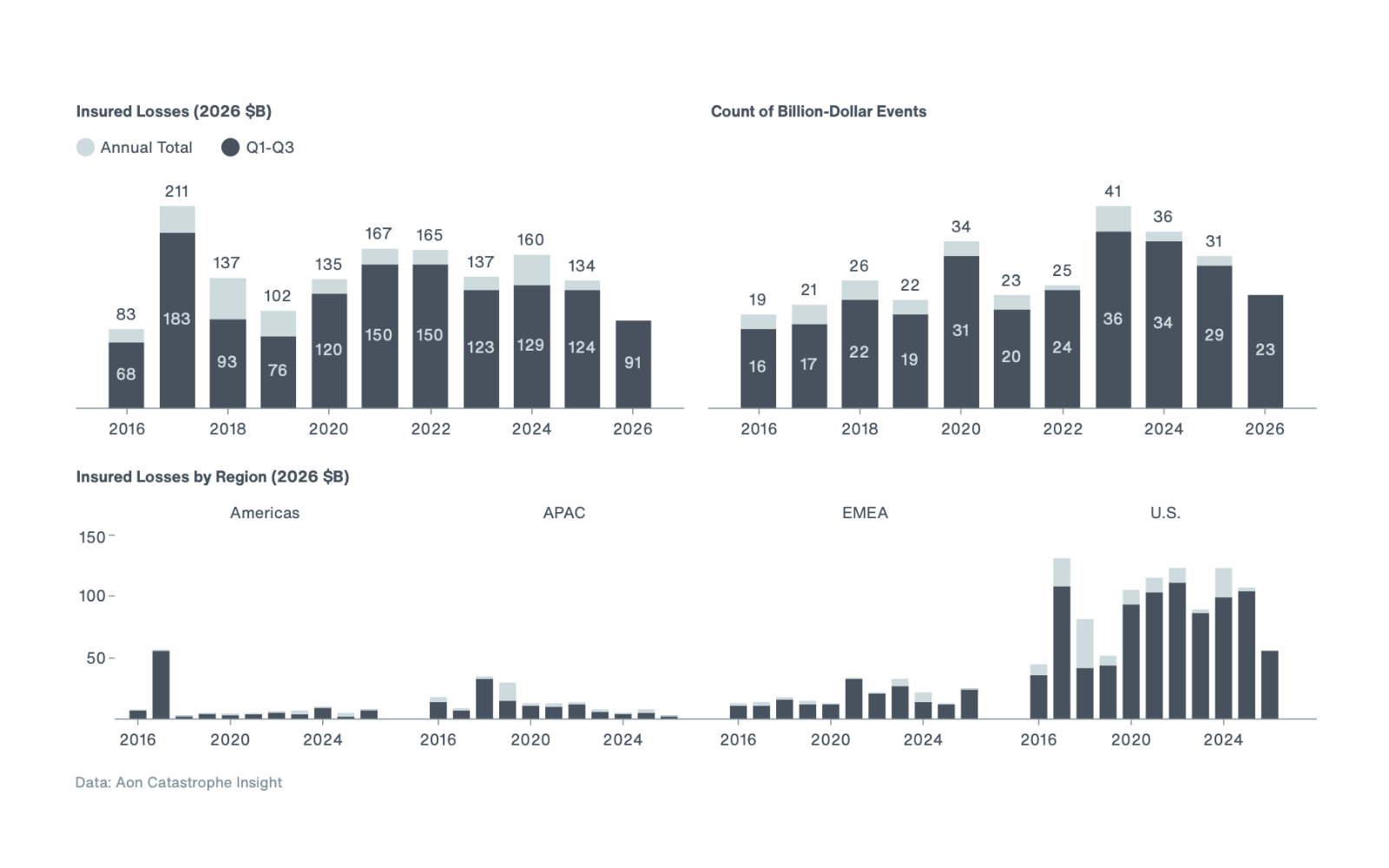
According to Aon, severe convective storms (SCS) were the costliest peril for both economic and insured losses, and 62% of global insured losses were recorded in the U.S.
The recap also found that European drought was the costliest insured loss event of the year to date, at more than $8.5 billion, while the Venezuela earthquake was the costliest economic loss event, at an estimated $25 billion.
Regionally, industry losses in Asia and Pacific were well below the long-term mean, while losses across the Americas were elevated due to earthquakes in South America and multiple notable events in Canada.
Despite the moderate aggregate figure, Aon found that 42 events generated economic losses of at least $1 billion each, above the long-term average of 37. Meanwhile, 23 events produced insured losses of at least $1 billion each, compared with a historical average of 14.
Michal Lörinc, Head of Catastrophe Insight, Reinsurance, Aon, commented, “Moderate global totals can mask significant regional impacts and emerging concentrations of risk.
“The first nine months of 2026 demonstrated the need to look beyond aggregate figures and understand how changing hazard patterns, exposure and insurance penetration affect communities, governments and businesses.”
The recap also highlighted that the global protection gap, meaning the share of economic losses not covered by insurance, stood at 55% for the first nine months of 2026.
Aon said major earthquakes in Colombia and Venezuela underlined the consequences of low insurance penetration in parts of Latin America.
The firm stated that the August 10 Colombia earthquake caused an estimated $9.6 billion in economic losses, making it the costliest global event of the third quarter.
“Insured losses and reinsurance recoveries are expected to be substantial but manageable, supported by established reinsurance programmes, catastrophe reserves and insurer capitalisation,” the firm added.
By contrast, the June 24 Venezuela earthquake generated an estimated $25 billion in economic losses, but insured losses are expected to represent only a small share because of limited insurance penetration and domestic market capacity.
Lörinc said that, taken together, the events demonstrate how major earthquakes can transfer a significant financial burden to households and governments where protection gaps remain wide.
He continued, “Through the development of proprietary analytics tools, and through working with our clients and markets worldwide, our aim is to reduce this protection gap and better serve communities, governments, and businesses wherever they are situated.”
Other findings from the recap showed that the human impact was lower than usual, with roughly 53,000 fatalities, 8% below the 21st-century average, driven mainly by heatwaves and earthquakes.
Climate indicators were also notable. Sixteen countries recorded their all-time maximum temperatures this year, and sea-surface temperatures in the Niño-3.4 region are running about +3°C (+5.4°F) above normal, reflecting a historic El Niño event that is still ongoing.