Based on the 2018 Florida catastrophe renewal, firm order terms (FOT) rate-on-lines (ROL) trended towards the lower end of quotes as capacity chasing continued in the marketplace, according to reinsurance broker JLT Re.
In its recently published study of property catastrophe reinsurance pricing – based on 2018 Florida cat renewal, JLT Re explains that pricing in the sector has come a long way since the introduction of cat models.
The broker notes that it has been using its in-house pricing tool, Layer Simulation Tool (LST), to improve the pricing process. And, in the study, explains that LST works on the principle of competition-based pricing over cost-based pricing.
Ultimately, and by using information from the 2018 June 1st renewal, JLT Re was interested to see how well its LST performed in predicting final ROL, as well as FOT ROL’s “level of efficiency in the context of the property cat market.”
The chart below, provided by JLT Re, shows the range of quotes for each first event layer and FOT ROL’s relative position to that quote.
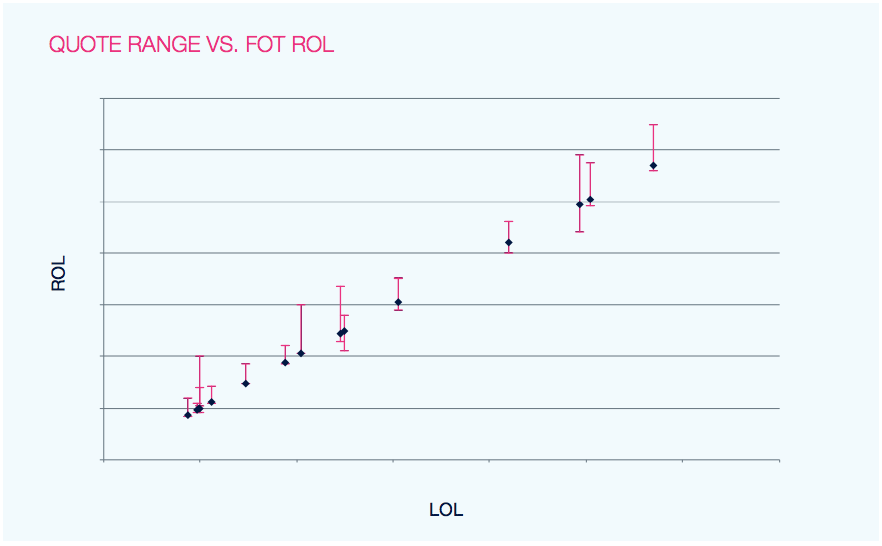
As highlighted by the chart and discussed by JLT Re, in most layers, FOT ROLs trend towards the lower-end of quotes.
“In a small number of exceptions, most notably a couple layers with high LOLs (in the top right hand quadrant of the graph), FOT ROLs are closer to the median quote. This pattern can be viewed as evidence of a flat to soft market, where markets, in chasing capacity, are willing to concede grounds on rates,” says JLT Re.
So, while the quote ranges were fairly broad, in the end, market participants were willing to offer lower prices.
Interestingly, the above is very similar to what happens in the catastrophe bond market, where a price range is put to market for a tranche of notes, with the final coupon typically settling in the lower-end of the initial range, and sometimes even below it.
Pricing in the market remains under pressure as capacity levels and competition are still high, despite consecutive large catastrophe loss years.