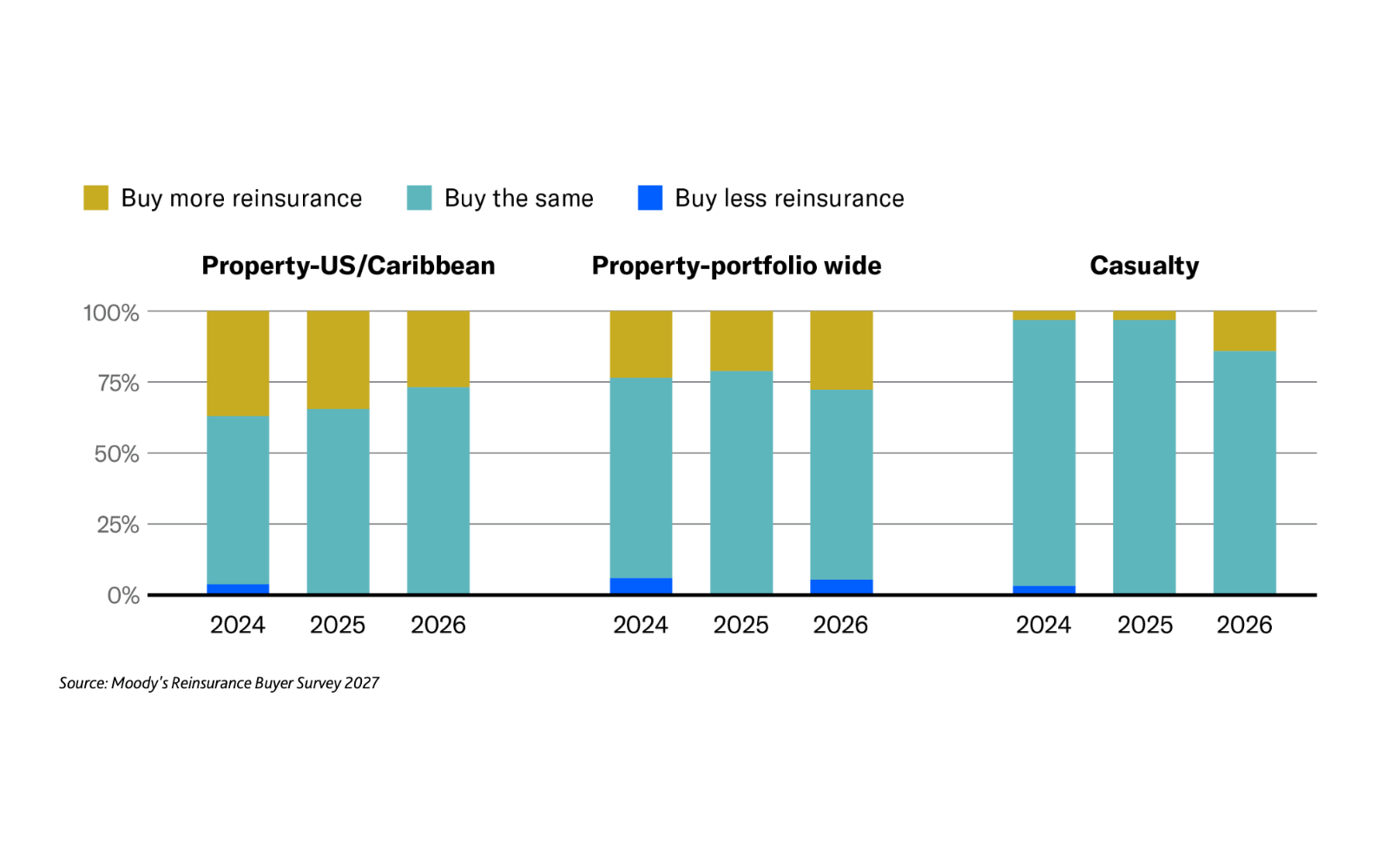
As primary insurers look to mitigate tail risk exposures as they expect an increase in the frequency and severity of catastrophe losses, more than 25% of respondents to Moody’s Ratings 2027 reinsurance buyers survey expect to purchase more property reinsurance in 2027.
Moody’s Ratings released its annual reinsurance buyers survey results ahead of RVS 2026 in Monte Carlo. The survey was conducted among Moody’s-rated P&C and composite insurers across North America, Europe, Middle East and Africa, and Asia Pacific, and the results summarise 40 primary insurers’ views on current market conditions and expectations for next year.
One of the questions Moody’s Ratings asked participants was whether they expect to purchase more or less property and casualty reinsurance in 2027. The results reveal that demand for property reinsurance remains strong, while most expect to buy the same amount of casualty cover.
More than 25% of respondents expect to buy more property US/Caribbean reinsurance next year, which is slightly lower than in the previous year. The remainder, almost 75%, expect to buy the same amount of reinsurance, with no responses signalling a desire to purchase less than in 2026.
It’s a similar story for property on a portfolio wide basis, with more than 25% expecting to buy more cover, almost 75% the same, although a small percentage do expect to buy less reinsurance.
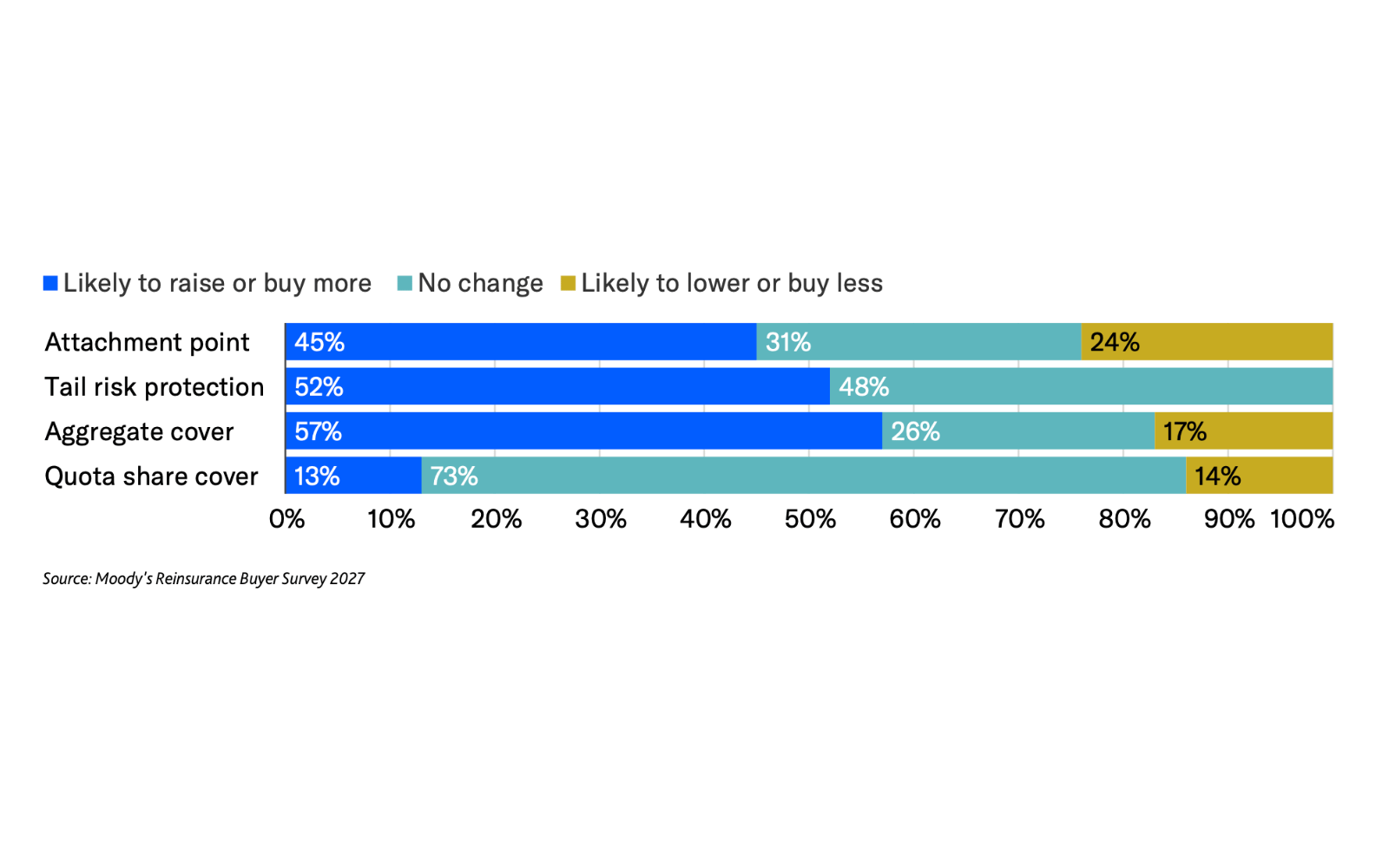
In terms of the type and structure of their property reinsurance purchases in 2027, the trend is that primary insurers will target buying more tail protection and aggregate cover, which is in response to the continual rise in the frequency and severity of secondary peril events such as severe convective storms, floods, and wildfires, which have dominated industry losses in recent years.
The data reveals that 76% of participants expect to maintain or increase attachment points, while 24% of respondents expect to negotiate a decline in their attachment points. “While terms and conditions stayed relatively stable in 2026, this decline could signal some easing of terms and conditions in 2027,” says Moody’s Ratings.
The rating agency does expect insurers to continue to retain the majority of non-peak cat losses, but the proportion shared with the reinsurance industry could increase again if attachment points do fall, although reinsurers will be eager to avoid past mistakes and not give up the structural changes achieved in the 2023 reset.
Roughly 52% of respondents to the survey expect to buy more reinsurance for severe, less frequent risk such as hurricanes and earthquakes, which Moody’s Ratings says reflects continued strong reinsurance capacity.
At RVS 2026, there was a lot of discussion around aggregate covers, a structure reinsurers moved away from amid heightened losses from frequency events. More than half, 57% of survey respondents expect to purchase additional aggregate coverage for 2027 to mitigate the impact of accumulated losses.
“Reinsurers largely scaled back these covers over the past decade following substantial losses, and their increased availability signals a more competitive market,” says Moody’s Ratings.
In terms of quota share cover, 73% of survey participants expect no change in their level for 2027, while 13% expect to increase their level, and 14% expect to reduce their level of quote share coverage.