Shortly after 6pm local time on Wednesday, Venezuela’s capital was hit by a Magnitude 7.2 foreshock and a larger M7.5 mainshock just 39 seconds later, with the US Geological Survey (USGS) giving a 44% chance of more than 10,000 fatalities, and a 45% chance the economic costs exceed US$10 billion.
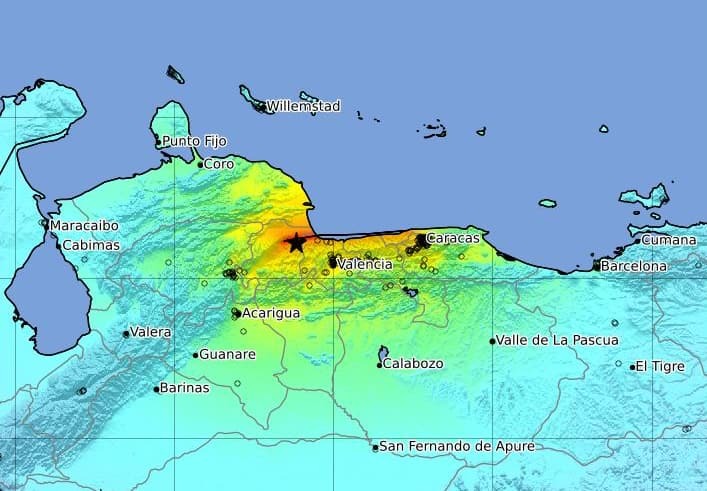 The quakes, according to several mainstream media reports, have destroyed buildings in the capital city of Caracas, with Venezuela’s Interim President, Delcy Rodríguez’s office stating that 32 people have died in the earthquake and some 700 people are injured.
However, the USGS believes there is a 44% chance of more than 10,000 fatalities, and a 30% chance of more than 100,000.
While the economic cost is expected to be high, it is still far too early to estimate insured losses driven by these quakes, but it’s safe to assume this could become one of the largest insured loss events in the country’s history.
So far, it is unclear whether Venezuela has any parametric earthquake coverage, public or private. However, it can be assumed that any parametric quake contracts would likely be set to trigger around a magnitude 7 or higher, so if there are any, they could be at-risk or triggered.
The first quake struck the area of Montalbán at a depth of 13.2km at 18:04 local time, according to the USGS. The agency also stated that tremors were felt as far away as the Colombian capital, Bogota.
“More than 20 aftershocks have rattled Venezuela since the first earthquakes hit on Wednesday,” reported news agency AFP, citing the President’s office.
The extent of the damage remains unclear as the Venezuelan authorities continue to assess the worst-affected areas. Acting President Rodríguez has declared a state of emergency.
According to the USGS, there is also a significant risk of landslides and liquefaction on the ground, which is a phenomenon that afflicts loose sediments in an earthquake and is closer to a lateral landslide.
Venezuela sits in a seismically active zone where the Caribbean and the South American tectonic plates meet. According to the USGS, the second and larger of the two quakes occurred as a result of “shallow strike-slip faulting” near the boundary of these plates.
Diosdado Cabello, Interior Minister of Venezuela, told state television that several states have been affected by the quake. He warned that in the capital, Caracas, the neighbourhoods of Palos Grandes and Altamira were worst hit.