
Hurricane Laura has intensified further securing major Category 3 hurricane status, raising concerns for the offshore energy market as the storm continues to head for the Gulf Coast, with forecasters warning of a major landfall.
As at 16:00 BST, Wed 26th August, data from the National Hurricane Center (NHC) shows that Hurricane Laura has maximum sustained winds of 125 mph with higher gusts, meaning the storm is now at Category 3 strength.
The NHC warns that “Laura is expected to rapidly strengthen to a Category 4 hurricane”, and is expected to drive catastrophic storm surge and extreme winds, with flash flooding expected along the northwest Gulf Coast tonight. The NHC adds that “only a few hours remain to protect life and property.”
Hurricane Laura’s minimum central pressure has fallen to 956 mb, while hurricane force winds extend outwards up to 70 miles from the centre as it continues to grow, ultimately threatening more land.
Additionally, the potential for “catastrophic” storm surge has also increased, with now as much as 15 to 20 feet expected in the worst affected coastal regions.
Analysis by Peel Hunt notes that the track of Laura is similar to that of Hurricane Ike in 2008, which resulted in insured losses of around $23 billion. However, Ike did make landfall as a Cat 4 storm, and while Laura is expected to intensify to this status later today, the forecast is for a Cat 3 landfall. Of course, this remains uncertain, but the level of damage caused by Laura could be far higher if the storm makes landfall as a major Cat 4 hurricane.
Property catastrophe insurers and reinsurers will be keeping a close eye on Laura as it tracks toward the Louisiana coast near the border with Texas, especially as a shift in its path to the west could see Laura make its way to Houston, threatening a substantial volume of properties and infrastructure.
Analysts also note the potential impact to the offshore energy markets as Laura’s track continues to move into an area with a high density of shallow water oil platforms.
“As such, the offshore energy insurance market will be on alert if Laura indeed becomes a major hurricane just before making landfall,” say analysts. This will be of particular concern to the specialist Lloyd’s of London insurance and reinsurance marketplace, which as highlighted by analysts, is an important hub for the oil industry.
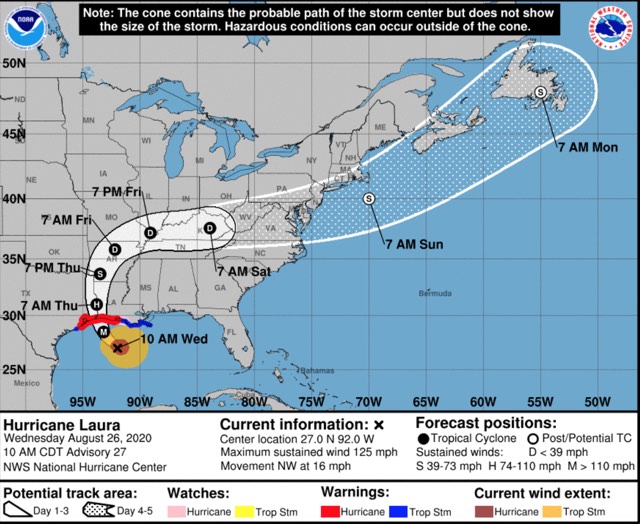
As highlighted by the image above, forecasters still suggest the chance of a shift westward and a landfall between Galveston Bay, Texas, and the Louisiana border. The Galveston Bay area boasts higher exposure values so the closer to this region that Laura makes landfall, then the greater the potential for insurance and reinsurance industry losses.
The track of Hurricane Laura and the expected intensity and landfall suggests that this will be a significant loss event for the insurance, reinsurance, and insurance-linked securities (ILS) markets.
According to our sister site, Artemis, sources in the reinsurance and ILS market have been discussing industry loss levels around the $10 billion to $20 billion mark, although widespread uncertainty remains owing to landfall location.
In light of this, sources explained that some interest and tentative quoting for industry loss warranty (ILW) based hedging instruments has been seen recently.
Hurricane Laura is set to become the first major hurricane of the 2020 Atlantic Hurricane season, which, many forecasters have said is very likely to be an above-average season for activity levels, as well as landfalls.