Fiona Marry, European CEO of specialty insurer Bridgehaven, said hybrid fronting has the potential to grow the insurance market by bringing new or underpenetrated risks into the market, making specialist underwriting expertise accessible to institutional capital, and making regulated capacity accessible to MGAs.
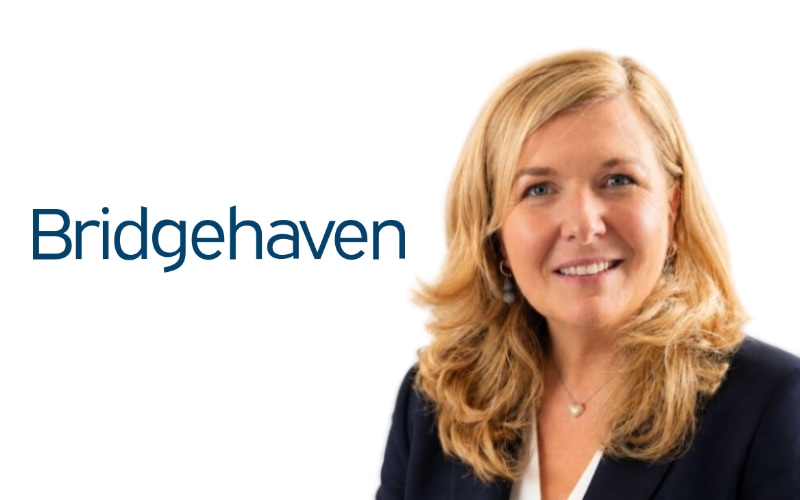 Bridgehaven is a specialty insurer which operates a hybrid fronting model across the UK and the EU, connecting MGAs with high-quality reinsurance capacity, and is focused on aligned risk retention, robust underwriting oversight, and strategic capacity partnerships.
In an interview with Reinsurance News around the annual Rendez-Vous de Septembre (RVS), the insurer’s European CEO said she sees hybrid fronting as the partner of the traditional insurance industry; another layer in the value chain.
She explained, “The industry has historically bundled underwriting, distribution and capital together inside one institution, and the MGA and hybrid-fronting markets are effectively unbundling those functions. That allows the industry to separate the things different participants are genuinely good at: specialist underwriting expertise, distribution, a regulated balance sheet, and risk-bearing capital.
“Traditional carriers can use hybrid platforms like ours to access specialist MGAs and new distribution without having to build every underwriting capability internally. Hybrid fronting companies, in turn, can combine the expertise, capital and relationships of established carriers and reinsurers with specialist underwriting businesses to help them scale.”
Marry noted that this can create access to risks, distribution and expertise that individual participants would not necessarily reach as efficiently on their own. As a result, she believes hybrid fronting can grow the market rather than simply redistribute it.
She added, “The real test, of course, is whether that unbundling produces better underwriting outcomes through the cycle, not simply faster premium growth.”
Meanwhile, Marry said she believes pure fronting can create a structural misalignment between the party writing the business, the party bearing the risk, and the party meant to be overseeing it.
“When the economics are largely detached from how the underlying book performs, there is very little incentive to intervene early if performance starts to deteriorate, when the risk has already been passed through to a third party,” she highlighted.
“There is a growing premium on carrier alignment, retention, governance and transparency, and that is where our hybrid model differentiates itself for example: the three parties, the MGA, Bridgehaven and the reinsurer, are aligned.
“Hybrid fronting, as we practise it, is not about providing paper and passing 80% or 90% of the risk straight through to reinsurers. Our model is based on retaining risk, underwriting and claims oversight, giving reinsurers transparency into the underlying portfolio, and giving high-quality MGAs stable, long-term capacity. That is the distinction, and it’s why we don’t ask reinsurers to trust an MGA’s underwriting from a distance. We put our own capital alongside theirs and actively manage the underwriting risk between the MGA and the reinsurer.”
Marry explained that Bridgehaven typically retains between 10% and 20% of the risk itself, so its economic outcome is directly connected to the MGA’s underwriting performance and to the reinsurer’s outcome.
“We are not at all indifferent to whether the book performs,” she said. “Our role is much broader than issuing the policy: we select the MGA, assess the underwriting proposition, establish the delegated authority, monitor performance, manage reserving and oversee the portfolio, and the reinsurer gets visibility of the same data and underwriting performance that we see.”
Marry said full data transparency is also key to giving reinsurers the confidence to commit capacity over a longer duration, rather than making one-year, one-off support decisions.
She emphasised, “Bridgehaven, the MGA and the reinsurer all need to be looking at the same portfolio and working from the same information. That is not an administrative requirement in our model, it is a foundational part of the underwriting proposition. We need granular, reliable data that lets us understand the portfolio, monitor performance and identify changes early, and the reinsurer gets visibility of exactly the same data and underwriting performance that we see.
“Once a reinsurer can see loss-ratio performance, claims development, exposure management and pricing discipline transparently, continuously and through regular granular portfolio reporting, rather than waiting for a renewal to find out what happened, they have far more confidence to commit capacity over a longer duration rather than re-underwriting the relationship every twelve months.”
Marry explained that Bridgehaven’s reinsurance panel is structured around that same principle of transparency and alignment.
“We are not asking a reinsurer to take a series of disconnected country or programme risks. Because we retain risk ourselves and sit in the middle actively managing it, we are able to aggregate and manage those risks at portfolio level, diversifying across MGAs, classes and territories, and give each reinsurer on the panel a much clearer view of what they are actually backing,” she said.
“It gives reinsurers an efficient way to access a diversified portfolio of specialist risks without having to build each individual MGA relationship themselves,” Marry explained.