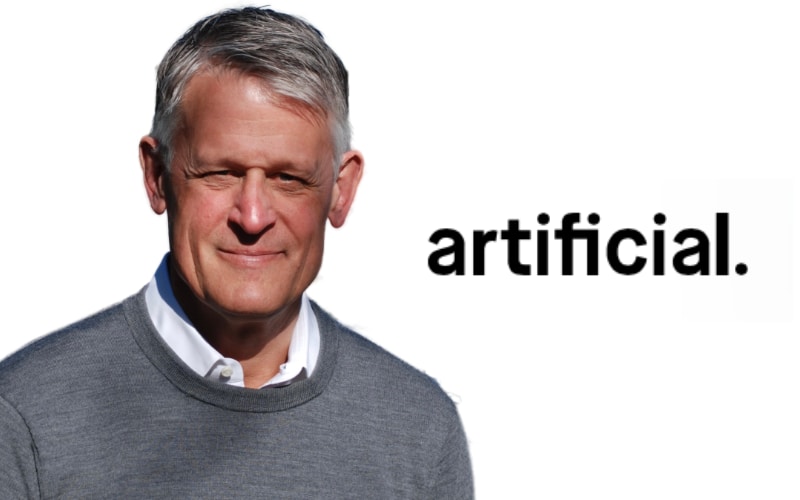
Eric Joost, President at Artificial, said the firm sees opportunities in the US re/insurance market, particularly across the wholesale market, MGAs, and more structured distribution models, as firms seek to manage increasing volumes of submissions and greater operational complexity.
 Established in 2013 and based in London, Artificial builds technology and software tools for commercial insurers and brokers, and provides clients with a cloud-based algorithmic underwriting platform and applications, which are able to be built on top of existing legacy systems.
Joost joined the company earlier this year to lead its US expansion, and in an interview with Reinsurance News, the recently appointed President noted that Artificial’s expansion into the US market is a natural extension of its existing business.
He explained, “A significant portion of the activity we support today in London already connects to US-based risk, which reflects how globalised specialty insurance has become. Many of the brokers and carriers we work with are already transacting across both markets, so the expansion is a natural extension of those existing relationships.”
Joost continued, “The opportunity is particularly relevant across the wholesale market, MGAs, and more structured distribution models, where firms are managing increasing volumes of submissions and greater operational complexity. There is no shortage of capital or underwriting expertise in the US, but there is pressure on how consistently that can be deployed as businesses scale. That is where we see a clear role for Artificial, supporting more structured, repeatable execution across those workflows.”
At the same time, Joost stressed that the US is not a market where a London approach can simply be transferred. While the underlying mechanics of insurance transactions are similar, the way those transactions are handled is different. As a result, Artificial is focused on adapting its approach to how the US market works in practice.
He noted that over the next 12 to 24 months, Artificial’s priority is to establish a clearer position in the US market.
“There is already some awareness of Artificial, but the more important step is making sure that this translates into a better understanding of what we do and where we are delivering outcomes for clients. That requires a more visible presence – both in terms of people and engagement – with the market,” said Joost.
“Building a footprint in the US is part of that, but the wider focus is on relationships and supporting clients as they navigate a technology landscape that is often discussed in broad terms but applied inconsistently. There is a large volume of activity around AI and digital transformation, but many firms are still working through how those tools fit into their business in a practical sense,” he added.
Joost also commented that, from a role perspective as President, the value comes from having experience across both the insurance business and technology sides.
“In this market, technology cannot be separated from the way firms actually operate. Being able to connect those two perspectives helps accelerate the process of translating what Artificial does into outcomes that are relevant to US clients,” he said.
“Success over that period is less about headline expansion and more about building credibility with the right counterparties, establishing where the platform works in practice, and demonstrating that it can support growth without adding operational complexity.”
Joost also spoke on artificial intelligence (AI) and its ability to deliver real value to clients.
He explained, “Much of the immediate impact continues to sit around data, specifically ingestion, normalisation, and the ability to work with consistent information across a transaction. Those issues have existed in the market for a long time and remain central to making digital trading effective. Improvements in these areas have a direct impact on the quality and consistency of decision-making.
“Internally, AI is also improving how quickly development work can be done, particularly in areas like prototyping and coding. But the more relevant point for clients is how technology is introduced into the workflow in a controlled way. The industry has seen multiple waves of new technology over the past decade, and the difference now is the extent to which it can be embedded into day-to-day execution rather than existing as a separate initiative.
“Having experience from implementations that are already live is important in that context. It allows the focus to move beyond whether a capability exists, and towards how it can be applied consistently across a business.”
Joost said the most immediate impact AI is already delivering today is in how information is organised and used.
“Underwriting and placement involve large volumes of data moving between different parties, often in inconsistent formats. AI is already helping to extract, structure and improve that information, which reduces the amount of manual work required and allows more time to be spent on decision-making,” he said.
“In that sense, the benefit is less about replacing underwriting judgement, and more about improving the inputs into that judgement. Where information is clearer and more consistent, it becomes easier to apply appetite, guidelines and pricing in a more structured way.
“There is also a broader shift underway in terms of accessibility. More advanced tools are increasingly being used directly at the desk, which changes how individuals interact with data, research and communication. That brings efficiency at an individual level, but it also introduces a second challenge around consistency.”
Joost noted that using AI in isolation is relatively straightforward, but scaling it across a team or a business — where multiple people need to operate in the same way and within appropriate controls — is more complex.
He concluded that the transition from individual usage to institutional adoption is likely to be the next stage of development for the market.