Reinsurance broker Howden Re reports that on a weighted-average basis, risk-adjusted property catastrophe rates decreased by up to 25% at the June 1 reinsurance renewal, an acceleration from the -14.7% and -16% declines the firm recorded at the January and April renewal periods, respectively.
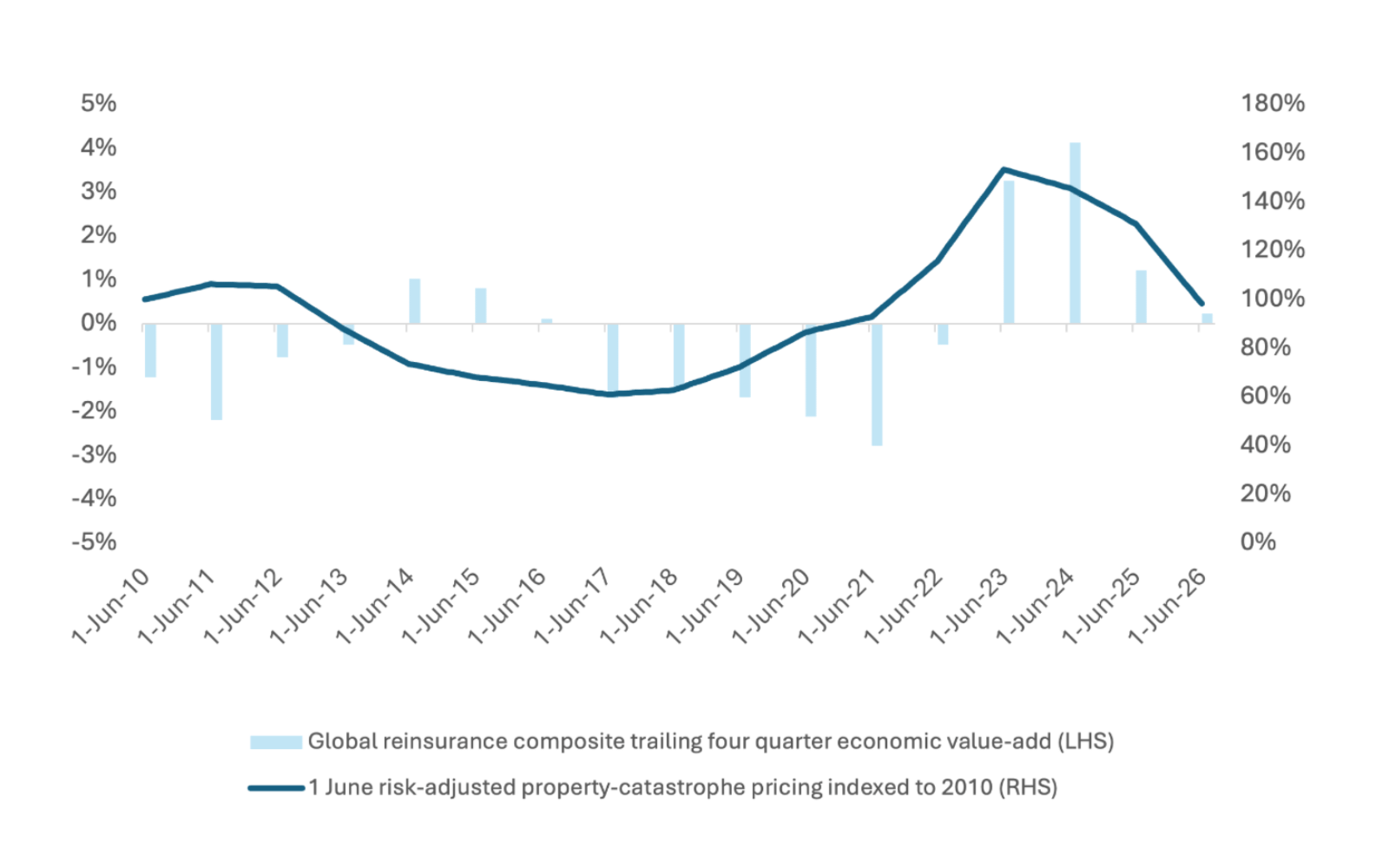
Howden Re’s risk-adjusted property catastrophe reinsurance rate-on-line (ROL) index at June 1 shows a continuation of the softening trend since the peak of the hard market in 2023, with the steepest reductions on loss-free programmes.
As pricing eased further for buyers of protection, Howden Re saw demand increase meaningfully as the placement window extended later than in recent years. According to the broker, at this renewal, cedents secured leverage on terms, structures, and signed lines through to closing.
The reinsurance broker reports that capacity was plentiful at 1.6, causing the supply demand balance to tilt further in favour of buyers, with most sellers “open to providing support” as cedents looked to secure expanded layers, traditional cascading all-perils coverage, and strategic protection for second and third events.
Howden Re highlights strong demand in Florida at the mid-year 2026 renewal, although notes that this was absorbed by the depth of traditional and alternative reinsurance capacity, as sellers showed more appetite for structures such as prepaid reinstatements, second-event and aggregate covers or top-and-drop combinations. Then firm also reports that reinsurers had increased appetite to participate at lower-attaching layers, a notable shift from recent renewals following the property market reset in 2023 when reinsurers moved higher up programmes as losses from secondary perils continued to rise.
“The coastal property market enters this hurricane season significantly stronger than at any point in the post-reform era. It is clear reinsurers have taken the time to understand the measurable benefits of the reforms in Florida. This understanding has manifested in a broadening appetite for Florida/Coastal Hurricane risk and capacity that is genuinely competitive at attachment levels difficult to fill twelve months ago. In addition, appetite has returned for structural enhancements, including traditional cascading all perils coverage and strategic horizontal protections, that add further financial security in the event of an active season,” said David Unsworth, Managing Director, Howden Re.
The chart below is Howden Re’s risk-adjusted property-catastrophe reinsurance rate-on-line index at 1 June vs reinsurer economic value-added.
Outside of Florida, June 1 placements also extended the softening trend seen at the January and April 2026 renewals, with Howden Re reporting that top layers attracted the most competitive pricing. The reinsurance broker also states that catastrophe bond execution provided “structural competitive tension at remote attachment points” at this renewal. Further, as in Florida, reinsurer appetite for combined structures, sideways covers, and aggregate features also expanded in other geographies.
David Flandro, Head of Industry Analysis and Strategic Advisory, Howden Re, commented: “The defining feature of this renewal is the dichotomy between higher inflation, interest rates and risk premia, and the direction of reinsurance pricing.
“Capital has rarely been more abundant in an environment of elevated risk exposure. The last hard market began with an interest-rate shock; today’s geopolitical landscape carries clear inflation and asset-side risks that could impair capital as quickly as they did three years ago. As economic value-add contracts, how much further pricing will fall before economics reassert themselves is the question which will define 1 January 2027.”